

Products and services

What happens when the systems built to repair harm become sources of harm themselves? In the 1950s Britain detonated twenty-one experimental nuclear bombs in Australia and the Pacific and sent tens of thousands of servicemen from the UK, Australia, New Zealand, and Fiji to build and maintain the testing sites. Decades later, many of these men fell ill and now attribute their illnesses to radiation exposure.
I wanted to know about the impacts of fighting for justice on those who had so doggedly pursued redress for decades, and how they have managed to persist despite years of setbacks and state denials.
In interviews and participatory research in New Zealand and the UK, I sat down with nuclear test veterans to hear their stories. I followed them into courtrooms and spent hours in their garages and home offices reading through their remarkable private archives with them: once-classified telegrams, denied pension applications, ministerial correspondence, faded medical records, often accumulated across thirty or forty years.
I came to understand that becoming claimants of nuclear injury took an immense amount of work and skill. They had learned to navigate diverse institutional arenas, each with its own rules of proof: medical consultations, epidemiological studies, freedom of information tribunals, government archives, pension appeal boards, and ultimately the UK Supreme Court.
Many admitted that the fight itself had affected their health, causing stress, anxiety, exacerbated disability, and sometimes financial and family strain. Health researchers have a vocabulary for this, describing the ‘secondary illnesses’ that follow a primary injury, or the ‘caregiver strain’ borne by families.
There is now evidence that engaging with claims systems raises rates of anxiety, depression, disability and financial precarity. But the language used to describe this separates an original injury from its later consequences, and this was not how veterans described their lives. They understood injury holistically, as a type of cascade, tracing connections across decades between the exposures of their youth, the illnesses of ageing, the denials they met, and their fears for their children.
For test veterans, it was not only radionuclides that had caused environmental injury. The same bureaucratic systems and military logics that had enabled radiation harm in the past endured to refuse them care in the present. Injury, for them, was not an event with an aftermath but something cumulative, political, and moral as much as physical, bound up with truth-seeking and recognition.
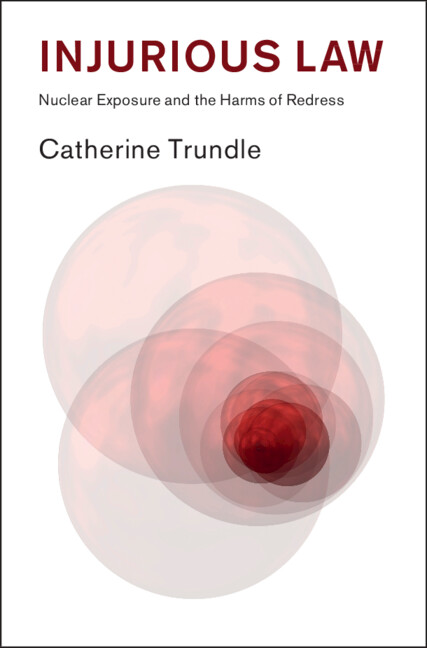
Injurious Law is my attempt to understand this. The medico-legal avenues these men navigated offered powerful possibilities for justice. Through them, veterans surfaced evidence that the state had refused to release, brought a secretive archive into public view, and helped establish that governments have positive duties to let people access their own health records. Yet these same medico-legal avenues compounded their injuries and produced new ones. This is what injurious law signifies: not law that simply fails to deliver justice, but law that wounds in the very process of promising justice and delivering some gains.
It would be easy to conclude that such struggles are simply injurious. I have resisted that conclusion. Claim-making also gave these men purpose, community, a language of critique, and a way of addressing the wrongs of the past. Injury and redress are entangled rather than opposed, and learning to hold that paradox is what the labour of claiming involves.
What I hope readers take from the book is a sharper question to ask of our own institutions: what they cost those who seek justice through them. And how might we imagine institutions for justice that don’t harm those who must engage with them?

Catherine Trundle is a senior lecturer in Health and Society at La Trobe University, Australia. She is a leading expert in health justice and ethics, and the co-editor of Competing...
View profile >Keep up with the latest from Cambridge University Press on our social media accounts.



Latest Comments
Have your say!