

Products and services


At the end of a war or genocide, there is a change in the rhythm of life. When weapons are laid down, focus moves from death and survival to relief, grief and guilt. Those who are alive start giving new meanings to their existence. This moment is the beginning of a long process of (re)building that involves individuals, communities, institutions and states. Stories and encounters that imagine futures different to the present begin to circulate. These narratives offer a site for reflecting on new meanings.
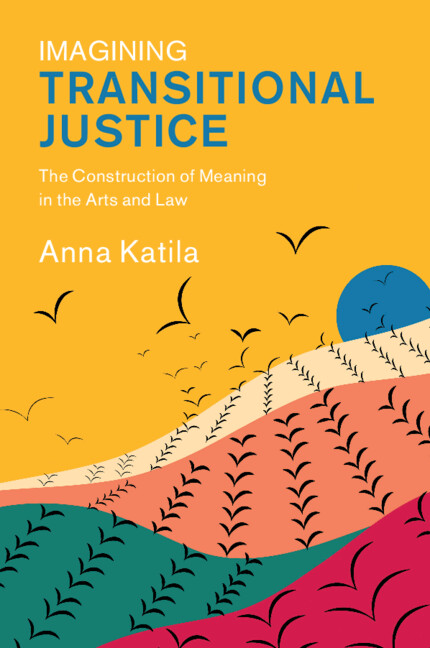
My book Imagining Transitional Justice: The Construction of Meaning in the Arts and Law starts with a fascination with this moment of change in the conditions framing existence. It turns to ‘reflective narratives’ – stories constructed in and through the arts and law – to show how these narratives construct and operationalise the notions of truth, justice, healing and reconciliation. In this book, I analyse novels, drama and film, alongside the archives of the International Criminal Tribunal for former Yugoslavia (ICTY) and the International Criminal Tribunal for Rwanda (ICTR). The creative and legal narratives differ in authorship, purpose, form and audience but share a delay between an experience and its narration. This opens up space for reflexivity and imagination. The resonances across the arts and law allow the legal and creative narratives to be set up for a meaningful analysis as distinct from other stories that circulate widely and internationally beyond state borders.
My analysis of reflective narratives applies ‘law and literature’ methods but seeks to avoid creating a hierarchy between the two disciplines, where one discipline is implemented as a corrective tool to another. Instead, Imagining Transitional Justice presents variations of a flexible entanglement of disciplines and objects of analysis; legal and literary frames inform understanding of legal and creative narratives.
The book’s readings of reflective narratives invite shifting of perspectives. The chapter on truth-telling highlights shared characteristics of personal, legal and forensic truths as social and partial instead of their separation. The chapter on justice begins with well-documented dissatisfaction with the ICTY and ICTR legal proceedings, proposing that conversations about a bearable level of injustice could help reflect on revise expectations of justice. The chapter on healing refocuses on those who do not heal and momentary alleviation of pain symptoms. The chapter on reconciliation advances a spatial understanding of reconciliation and its absence. It considers some conditions supportive of the space of reconciliation, such as trust and shared culture or history, while identifying that fear and physical distance maintain its absence.
Based on close engagement with narrative sites, I contend in Imagining Transitional Justice that reflective narratives encompass conceptualisations of the processes of (re)building lives and societies. The book invites reflection over how narratives and imagination can contribute to knowledge about transitional justice. It also advocates for listening to stories in the wake of war and genocide as they ground us in recognition of our shared humanity.

Anna Katila's interdisciplinary research focuses on transitional justice, peace, methods, memory and postcolonialism, analysing legal, creative and media narratives. She has publis...
View profile >Keep up with the latest from Cambridge University Press on our social media accounts.



Latest Comments
Have your say!