

Products and services


Artificial intelligence can discriminate. Climate policies can fail when they ignore scientific evidence. Disinformation can distort public debate before citizens can make informed choices. These are different challenges, but they share one feature: each concerns how scientific knowledge and technology are produced, used, governed, and shared.
Law already addresses parts of this terrain. We have data protection rules, environmental regulation, media law, or intellectual property regimes. Yet these frameworks are necessarily fragmented. They regulate particular risks or sectors, while the central role of science and technology in responding to today’s challenges often remains out of view. A largely overlooked human right can help to connect these dots: the right to science.
The right to science was recognised in the Universal Declaration of Human Rights in 1948 and made legally binding through the International Covenant on Economic, Social and Cultural Rights in 1976. It is not a right to science in the abstract. It is a bundle of entitlements that includes the right of everyone to enjoy the benefits of scientific progress and its applications, alongside state duties to conserve, develop, and diffuse science, protect the freedom indispensable for research, and promote international cooperation.
That makes it particularly relevant today. Science and technology now shape many sectors, such as health care, education, national security, democratic debate, and the economy. Yet the right that speaks most directly to their governance has remained largely dormant. It rarely appears in litigation, receives limited attention in human-rights scholarship, and is seldom invoked by the people it is meant to protect.
Two facets are especially important for confronting AI, climate change, and disinformation. First, the right to science requires public decision-making to engage seriously with the best available scientific knowledge. It therefore supports evidence-informed policymaking, whether governments are regulating AI systems, setting climate policy, or responding to misinformation. It does not dictate a single policy outcome. Rather, it demands that public authorities take scientific evidence seriously, make the relevant knowledge accessible, and enable meaningful participation in decisions shaped by science and technology.
Second, the right to science protects people against the adverse effects of scientific and technological progress on their human rights. Technological innovation can bring immense benefits, but it can also entrench discrimination, deepen inequality, or expose individuals and communities to new forms of harm. Algorithmic decision-making may reproduce bias. Health technologies may remain inaccessible to those who need them most. Scientific agendas may exclude researchers and communities from the Global South.
These two facets belong together. Evidence-informed policymaking without attention to rights can legitimise harmful technological choices. Protection against harm without access to scientific knowledge can leave communities unable to challenge those choices. The right to science provides a human rights framework for holding both concerns together. It asks not only whether science and technology advance, but also whose knowledge counts, who benefits, who bears the risks, and how those affected can participate.
This is why the right to science should not remain in a legal twilight zone. It offers a shared legal language for challenges that are often treated separately, and it places equality, participation, accountability, and the public good at the centre of scientific and technological governance.
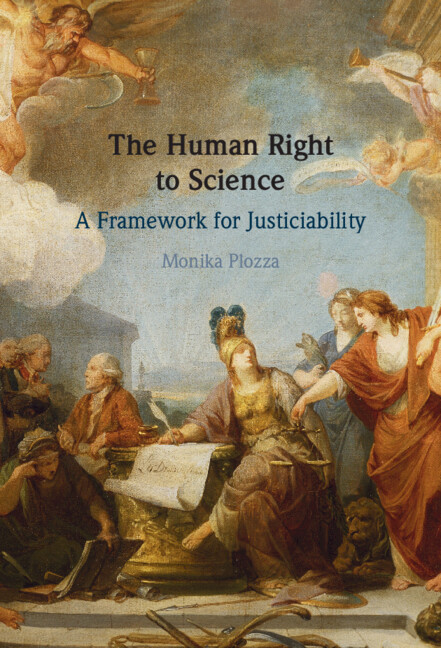
My book examines what it would take to make this right enforceable – not merely a principle cited in policy papers, but a right that people can invoke to demand evidence-informed decisions and protection from the harms of science and technology. It seeks to give this long-neglected right the normative content needed for practical use.

Monika Plozza is a postdoctoral researcher and lecturer at the University of Bern. She is also a member of the Swiss Young Academy....
View profile >Keep up with the latest from Cambridge University Press on our social media accounts.




Latest Comments
Have your say!