

Products and services


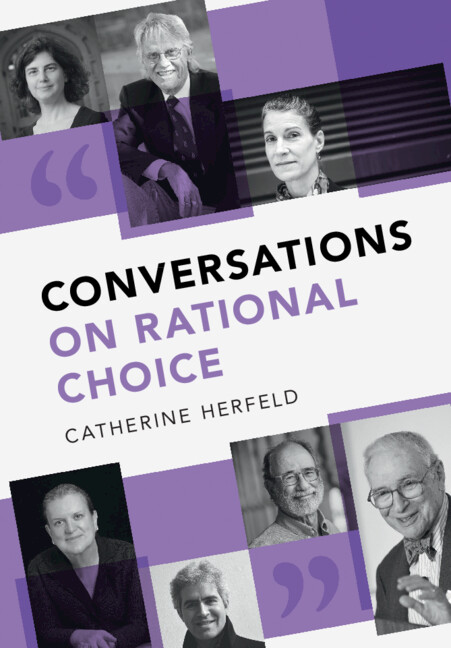
Scientific theories have long appeared as polished systems of ideas, presented through equations, models, and textbook explanations. This holds especially for economics. Yet behind every theory there usually lies a rich history of intellectual debate, sometimes accompanied by considerable confusion and disagreement. Conversations on Rational Choice offers readers an opportunity to explore not only the technical and substantive details of rational choice theories in light of different intellectual traditions. It also provides insights into the sociological and historical dimensions of the nature, use, and perceived usefulness of rational choice theories in economics.
“Rational choice theory” has long been used as a label for a set of the most influential frameworks in economics for modeling human agency. At their core, these frameworks assume that individuals make rational decisions by evaluating all options available to them and choosing those that best satisfy their preferences. While originating in economics, this seemingly straightforward idea has influenced how we model human agents not only in the social sciences but far beyond. However, theories that provide a systematic formulation of this idea have also long faced significant criticism regarding their assumptions about people’s preferences, cognitive abilities, and motivations. Such criticism has even sparked new research fields in behavioral economics and neuroeconomics, some of which have suggested alternative approaches.
Conversations on Rational Choice gives an overview of different rational choice theories and the criticism surrounding them. It thereby touches on long-discussed issues associated with these theories, such as the mathematization of economics, how to interpret the concept of rationality, the nature of preferences, and the need for psychology in economics. It does so by bringing together conversations with leading scholars who have shaped these debates over the past sixty years by applying, developing, or criticizing rational choice theories. Through interviews with 23 prominent economists, philosophers, and social scientists, including seven Nobel laureates, the book presents their diverse perspectives while also tracing their intellectual journeys and roles in the debate.
Given that the literature on rational choice theories can be rather technical and mathematically challenging, one contribution of this book is its use of the conversation format to present the technical aspects of these theories in a more accessible way. Some of these conversations provide valuable context about the historical development of rational choice theories, while others reveal the pragmatic considerations surrounding the actual use of such theories in economic practice. Given that each conversation is prefaced by a short introduction to the interviewee’s work, the respective views and approaches are located within the broader landscape of the scholar’s general outlook and research approach. Readers thereby gain insight not only into what scholars think rational choice theories are, but also why they hold particular interpretations of rationality, how they technically approach the concept of rational choice, and how they defend or criticize rational choice theories in light of their broader views.
The conversations also highlight the diversity of perspectives surrounding rational choice. While some scholars defend the theory as a powerful analytical tool, others question its epistemic usefulness because of its inability to accurately capture the complexity of human decision-making. This balance prevents the book from becoming a simple endorsement or rejection of rational choice theories. Instead, it encourages readers to critically evaluate both their potential and their limitations.
Another important contribution of Conversations on Rational Choice is its interdisciplinary perspective. Taken together, the conversations show how a comprehensive appraisal of a theoretical framework can benefit not only from the perspective of a practicing economist but also from philosophical reflection and psychological insights, all contextualized through a historical lens. By examining rational choice theories from multiple perspectives, the book helps readers understand the pragmatic, epistemic, and methodological arguments for retaining them as a central approach to human behavior across many disciplines. As such, Conversations on Rational Choice can be a valuable resource for students and researchers seeking to understand the diversity, intellectual foundations, and continuing uses of a major theoretical framework in contemporary economics.
Ultimately, the book aims to target different audiences. For historians of economics, some of these conversations can serve as oral sources for exploring intriguing aspects of the history of rational choice theories, such as Tom Schelling’s denial that game theory ever had any influence on political decision-making or strategic political thinking during the postwar period in the United States; Martin Shubik’s reflections on the history of gaming; or Kenneth Arrow’s recollections of how he became interested in questions concerning the existence of equilibrium. For economists, it may be striking to observe how much disagreement actually exists about ideas that the profession often presents as straightforward, widely accepted, or even as defining features of economic modeling. Finally, for philosophers of economics, the main takeaway is that, aside from recognizing the nuances in the use and justification of rational choice theories, we should be careful in assessing what economists do by taking into account feasibility constraints and the specific modeling goals they pursue. The book concludes with a plea for appraising theories through local critique, that is, evaluating them in light of their epistemic context and intellectual tradition. Ultimately, Conversations on Rational Choice reminds us that rational choice theories are not a unified and static framework but rather a set of evolving theoretical approaches embedded in an epistemic context that is itself subject to change.

Catherine Herfeld is professor of philosophy and history of economics at the Leibniz University Hannover, Germany. Her research concerns the history and methodological appraisal of...
View profile >Keep up with the latest from Cambridge University Press on our social media accounts.




Latest Comments
Have your say!