

Products and services

In Thomas Johnson’s updated 1636 edition of John Gerard’s The Herball, or Generall Historie of Plantes, there is an image comparing the ‘true’ and ‘feigned’ figures of ginger. Johnson explains that ‘the world has been deceived’ by the fake picture, circulated by another botanist, and so he is including it here alongside with the real one.
If you were to simply look at this page, you wouldn’t necessarily know which plant is ‘true’ and the other ‘false’. They’re the same size, and they appear side-by-side.
In my book, I argue that the inclusion of both images tells us something about how knowledge was being produced in the seventeenth century. That is, it requires tension. The framing of the page tells us that ‘true’ ginger is true because the false one is not. This constructive paradox also helps us to understand how knowledge spaces, such as a library, worked.
Hans Sloane (1660-1753) was a man often described as an ‘omnivorous’ or ‘undiscerning’ collector of various curiosities, plants, and books. His collections formed the basis of the British Museum, the Natural History Museum, and – along with a few other founding collections – of the British Library.
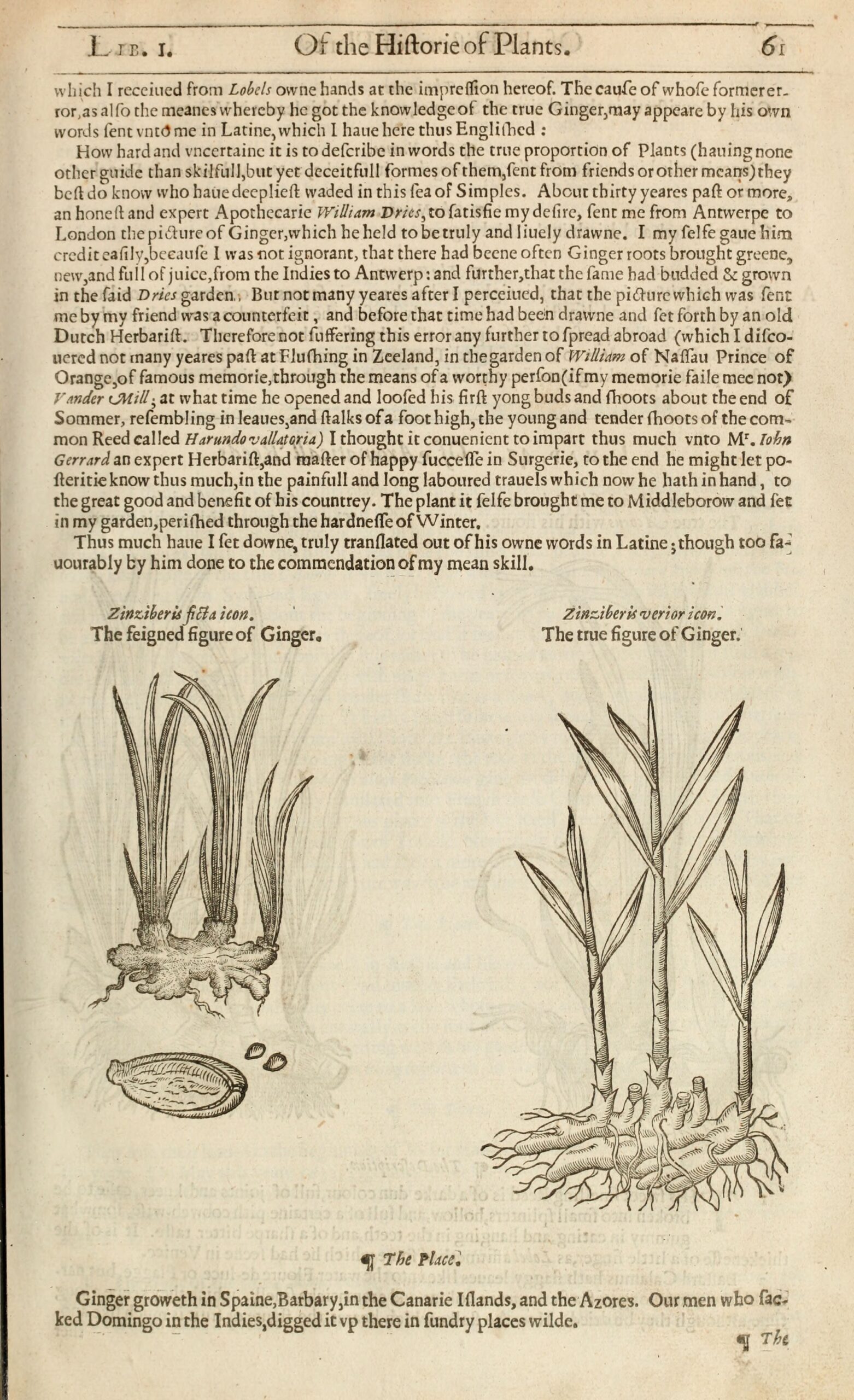
Image Credit: Page from The herball, or, Generall historie of plantes / gathered by John Gerarde… ; very much enlarged and amended by Thomas Johnson. Source: Wellcome Collection.
Image Description: A page from a book. The top half shows text. The bottom half shows two woodcuts of plants, both with three stems growing from an exposed knobbly root. The left picture is labelled ‘the feigned image of Ginger’ and the right ‘the true image of Ginger’
When I started working on his library collection, which consisted of around 45,000 printed volumes and 3,500 manuscripts, I thought I would spend six months or so getting to grips with what belonged in the library as opposed to the museum before moving on to other questions. However, I soon realised that delineating these two collections not only wasn’t possible, it also wasn’t helpful. Instead, I began to conceive of the library space as something more fluid: a space in which it was the bringing together of things and books, of discarded ‘false’ ideas and new suggestions, which produced new knowledge.
This is something which maps onto all our various understanding of libraries, whether research ones, local public ones, or even historical ones, all which happily combine books and other objects. At the same time, the job of cataloguing a library object often requires making decisive records in a strictly delineated set of fields: without this restriction, it would be impossible to locate anything. So, the openness I recognised within Sloane’s collection is also something that the library as we understand it today must resist in order to function.
There is therefore a tension between a catalogue or theoretical system of organisation and the realities of materiality and use. Sometimes, the shelves have their own ideas about where something fits; even people can disagree. Dried plant specimens which were kept in bound paper volumes caused a consternation when the British Museum was founded and the decision was made to keep them in the library. James Empson, one of Sloane’s executors, insisted that ‘dried plants more properly belong to a museum than a library’.
My book does not try to resolve this anxiety about what ‘properly’ belongs where. Instead, guided by Johnson’s ginger, I argue that the knowledge of a library is shaped through what it brings and holds together, as messy and frustrating as that might sometimes be to navigate.

Alice Wickenden is currently a Leverhulme Trust Early Career Fellow at the University of Cambridge working on a project called 'The Material and Ethical Afterlives of Named Collect...
View profile >Keep up with the latest from Cambridge University Press on our social media accounts.



Latest Comments
Have your say!