

Products and services


Our guess is that most people’s arms are still bolted tightly to their sides. If so, this book is for you.
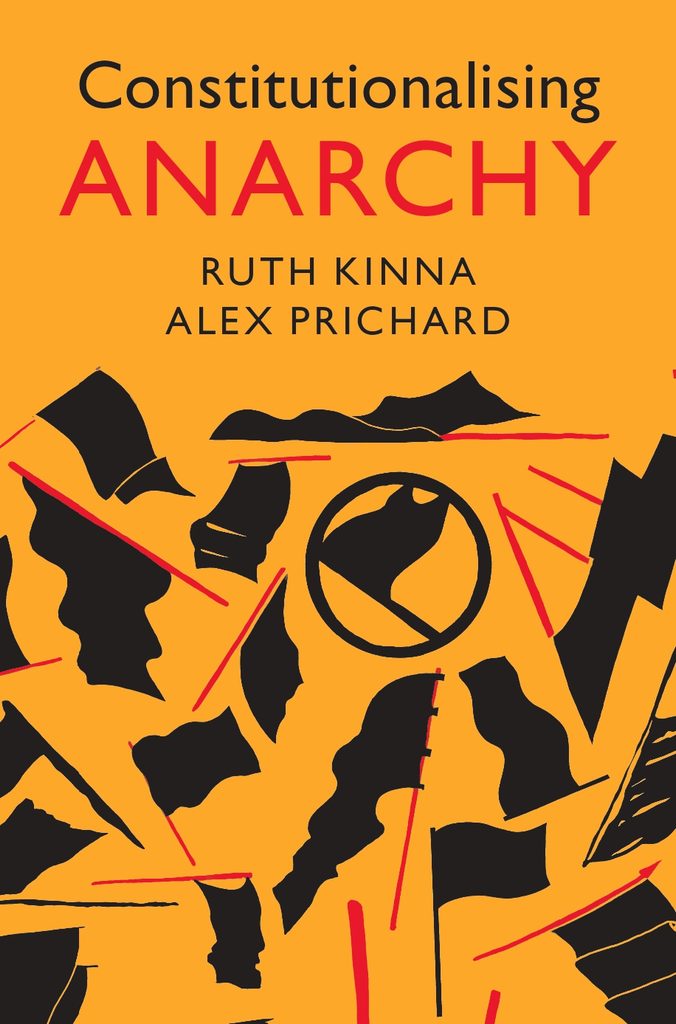
Constitutionalising Anarchy blows a hole in the conventional claim made by legal and political theorists that political constitutions are the exclusive reserve of states. Exhuming the body of nineteenth century anarchism to outline a now dead constitutional tradition, we reject that view.
We define the anarchist constitution as a process led by non-state bodies which enables groups and individuals to self-govern through plural, complex relationships consensually and by conscious agreements that can change. The anarchist constitution emerges from discussions about principles of association, institutional arrangements, rules and decision-making procedures. It looks a lot like an ordinary constitution except that it has no fixed or final point of authority. In fact, a range of scholars from multiple disciplines are already anarchising their theories of the constitution in this way, but they stop short of advocating anarchism. Our aim in the book is to push that effort forward.
One of the key arguments of the book is that the absence of sovereignty is not a lack. The anarchist constitution is not a critique, not a rehash of the liberal or republican version with the authority removed. This is the picture constitutionalists sometimes paint to dismiss anarchy as chaos. This critique is underpinned by an account of anarchy as a self-regulating condition. Our reconceptualization of anarchy reveals the state constitution as an arbitrary attempt to impose order on a fluid natural condition and reclassifies the anarchist constitutions as the instrument that maintains its openness and flow.
Is this all pie in the sky? No. Our analysis shifts from anarchist theory to practice, turning a critical eye to the constitutional processes of three iconic grassroots movements, the Industrial Workers of the World, the Occupy camp in Oakland California and Radical Routes, a UK housing co-op. We ask how the antiauthoritarian ideas anarchists set out 150 years ago are implemented by ordinary people, with no special training or legal expertise? We discover that their practices are anarchist even if their memberships are not, because underpinning their practices are core anarchist ideals like mutual aid, equity, self-government and ‘individual sovereignty’. We conclude that anarchy is a measure and protector of social diversity and plurality. The anarchist constitution enables individuals to express their disagreements in and through groups, without resorting to violence to settle them.
To show that Constitutionalising Anarchy is not just for anarchists, we show that the rejection of anarchy in mainstream and critical thinking is misplaced. The book engages with a broad body of scholarship in contemporary political theory, international relations theory and global constitutionalism. It shows why anarchists reject mass constituent power, appeals to the mass demos like ‘we’re the 99%’, and how they correct the biases of neo-Roman republicanism, specifically the claim we need states to protect us from domination. It also boldly re-purposes Hans Kelsen’s pure theory of law to flesh out a concept of the anarchist grundnorm. Our big claim, twisting Kelsen somewhat, is that anarchy is both the ‘ought’ and the ‘is’ of politics and law: there is no final point of authority in politics, nor should there be.
The tragedy of constitutionalism, we argue, is that anarchism is still being dismissed even while contemporary critical theorists reflect deeply on fascism, latent and active, a function of a craving for uniformity in the face of inevitable societal entropy, and on the modern state’s reliance on the forces ‘law and order’ to sustain or maintain egregious inequalities of power and wealth.
Who killed the anarchist constitution? Dario Fo’s The Accidental Death of an Anarchist has the important leads. His farce about the murder of Giuseppe Pinelli thrown out of a fourth-floor window in Milan central police station in 1969, reflects on the tragedy of death of innocents, the complicity of all in the vilification of anarchists, and the reflex to forgive the state’s violence as the necessary execution of the fool of modern politics. No matter how many times the mainstream and critical literature is scandalised by existing constitutional arrangements, anarchy is brushed off as immature utopianism. But ultimately, the joke is on us because righteous indignation gives way to a realist reset and the common sensical denunciation of the anarchist. Once everyone’s stomach has settled, everything returns to normal.
When they’ve read this book, we hope that more people will not only put their hands up to the anarchist constitution, but also vigorously signal their support.
Keep up with the latest from Cambridge University Press on our social media accounts.




Latest Comments
Have your say!