

Products and services


This new book, Providence, Evil and Salvation – a Thomist Perspective attempts to address some questions central to the Christian faith: How can we square the belief in God with the existence of evil? What is ‘sin’? What, if anything, could the claim that God ‘saves’ the world in Christ possibly mean? How do we ‘appropriate’ the healing that Christ brings? What resources does the Christian narrative have in a world in which most people live lives of quiet resignation, if not despair? What positive difference can the theological virtues of faith, hope and love make to our outlook on the world?
I have addressed these questions throughout my career in many articles, but the topic required a fuller synthesis. This inspired me to write this book. Addressing these questions primarily through the lens of Thomas Aquinas’s writings hopefully provides a focus and cohesion that would otherwise be missing in the book.
This book is not, however, a merely historical-theological account of Aquinas’s views. It offers, more broadly, a systematic-theological response to key questions from a Thomist perspective. As I see it, Aquinas is a classic author in the sense that Gadamer uses this term: his writings undoubtedly bear the mark of the intellectual context in which they were produced (13th century scholasticism), and yet they speak to all ages, addressing today’s concerns and questions.
At times, Aquinas’s views can challenge ours. In my view, much of twentieth century soteriology is theologically poor, primarily because it is not sufficiently Biblical, or because it does not sufficiently ponder the nature of providence and the relation between divine and creaturely agency in particular. This lack of philosophical reflection results in a rejection of the view that the Cross – an instrument of torture – is central in restoring the broken relationship between God and his people. Others in the twentieth century are happy to defend the soteriological significance of the Cross, but they interpret it in penal terms (as in Evangelical theology) and even attribute this view to Aquinas himself. I consider this interpretation implausible. I should add that Aquinas’s theory of salvation does not simply focus on the Cross, even though that remains key. For instance, he also develops what I call ‘a sacramental model’ that reminds us of the deifying energy operative in the world through the Incarnation.
Whilst Aquinas’s soteriology can challenge later developments, I do think his views on original sin and its transmission need to be critically revisited in a post-Darwinian age. This is perhaps the most controversial aspect of the book. Even here, however, Aquinas offers interesting resources, especially his notion of inattention or lack of consideration as a cause of sin, which I bring into dialogue with Hannah Arendt’s disturbing portrayal of Otto Eichmann.
Finally, Aquinas’s views on faith, hope, and love offer a wealth of theological insights, especially in his treatise on charity. (As explained in the book, charity instils all our relations with others and the world with a sense of gratuitousness, deeply resistant to instrumentalization). How we appropriate Christian salvation in our lives is the ‘subjective’ dimension of Aquinas’s soteriology. This happens through the theological virtues, as well as through participation in the life of the Church and sacraments (the topic of the final chapter).
A brief ‘Afterword’ concludes the book. To illustrate the theological and pastoral significance of Aquinas’s views, I discuss a contemporary and highly debated issue in the UK today: proposals to introduce assisted suicide (euthanasia). I uncover some of the foundational presuppositions that govern the discussion, rendering the views for and against effectively incommensurable: on this fundamental issue, a common ‘measure’ between religious and post-religious perspectives appears to be lacking, which makes negotiating the opposing views on the meaning of life, suffering, and death, and the identity, dignity and value of the human person difficult, if not impossible. Here in particular the countercultural and critical potential of the Christian worldview comes into prominence.
In summary, the main purpose of this book is to offer a coherent outline of key aspects of Christian salvation – both objective and subjective – from a systematic-theological perspective that is informed by an engagement with Aquinas’s own writings, with a pastoral sensitivity throughout.
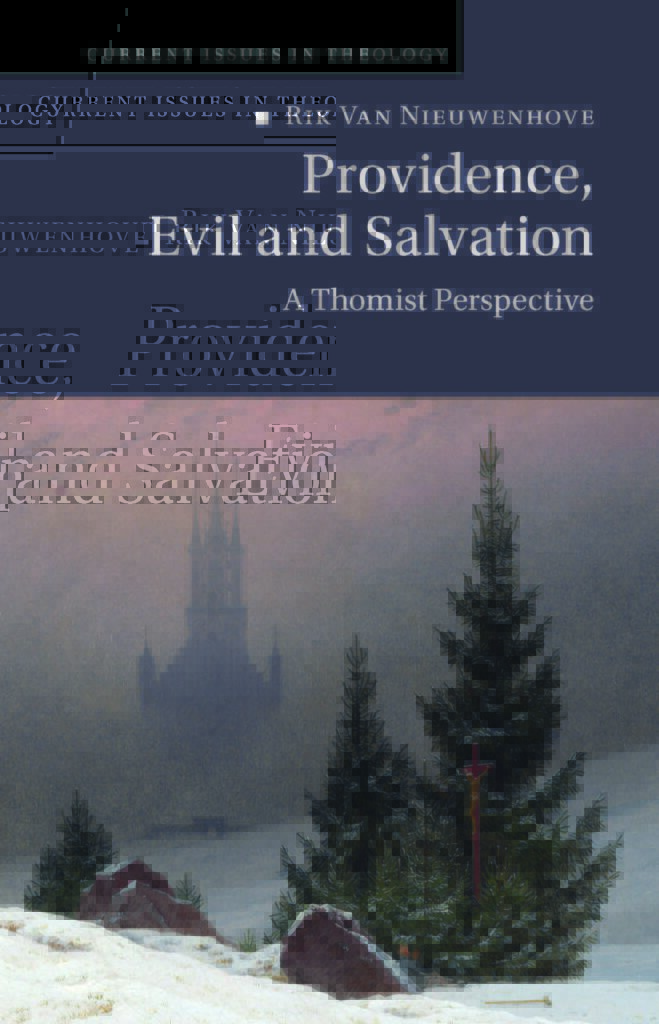
Providence, Evil and Salvation by Rik Van Nieuwenhove

Rik Van Nieuwenhove is Professor of Medieval Theology at Durham University, UK. His scholarly interests include scholastic theology (especially Thomas Aquinas), spirituality of the...
View profile >Keep up with the latest from Cambridge University Press on our social media accounts.


Latest Comments
Have your say!