

Products and services


When people hear about artificial intelligence in justice, they often imagine a dystopian future in which a “robot judge” decides cases, replaces lawyers, and turns justice into a cold, automated process. That image is dramatic, but it is also misleading.
What is actually happening is both more interesting and more important.
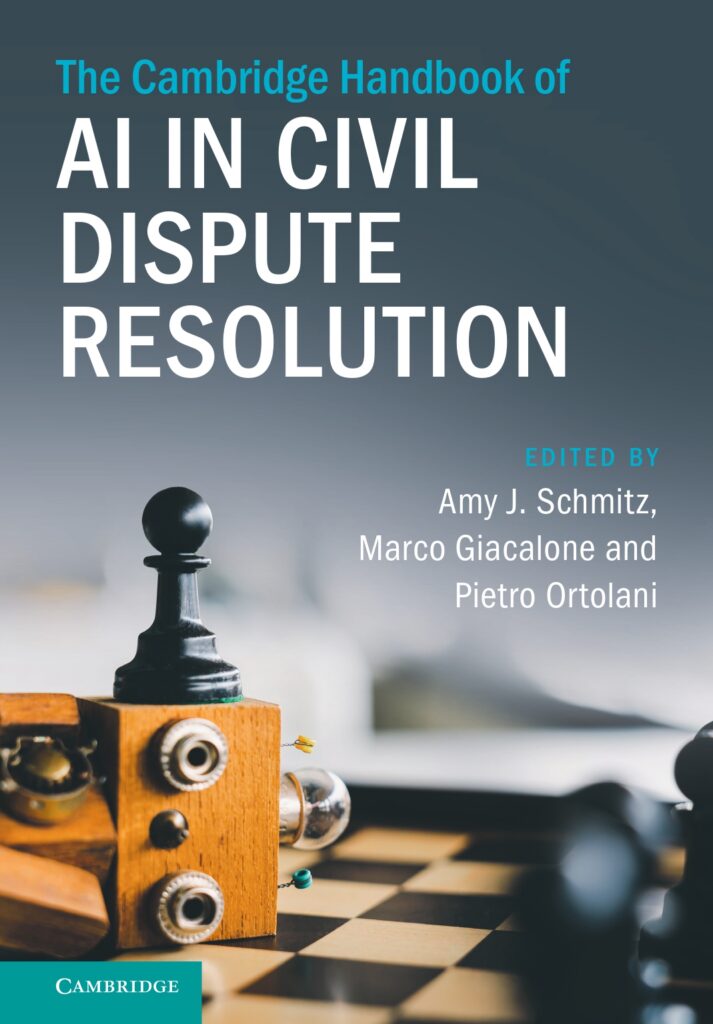
AI is already beginning to reshape civil dispute resolution, not simply by replacing human actors, but by changing how legal systems work around them. In The Cambridge Handbook of AI in Civil Dispute Resolution, we explore this transformation across a remarkably wide range of settings: public courts, online dispute resolution platforms, mediation, arbitration, access-to-justice tools, and systems designed to help people understand and navigate disputes before they escalate.
One of the central messages of the book is that AI in dispute resolution is not just about adjudication. It is also about access. In many legal systems, the real problem is not that people are judged by machines, but that they never meaningfully reach justice. Civil justice is often too expensive, too slow, too complex, or too inaccessible for ordinary users. Against that background, AI can offer real promise. It can help organise large amounts of legal information, support case management, assist users in understanding procedures, and make certain forms of dispute resolution easier to access.
But that promise comes with equally serious risks.
AI systems can reproduce bias, obscure reasoning, weaken accountability, and encourage overreliance on outputs that appear authoritative but are not necessarily accurate or fair. In the justice context, those risks are amplified. A small error in an entertainment app is one thing; a flawed recommendation in a legal dispute is another. That is why the debate cannot be reduced to a question of whether AI is “good” or “bad”. The real question is how it is designed, deployed, regulated, and supervised.
This is also why a comparative perspective matters. The book brings together examples from different parts of the world, from predictive and administrative tools in Brazil to generative AI in the Dutch legal system, China’s internet courts, and European debates shaped by the EU AI Act. These examples show that there is no single pathway for AI in justice. Technologies develop differently across jurisdictions because legal traditions, institutional capacities, and normative priorities differ.
So where does this leave us?
In our view, AI should not be understood as a substitute for justice, but as a structural force that is already reshaping it. That makes careful governance essential. We need systems that are transparent, human-centred, and attentive to due process, fairness, and inclusion. In the European context, this is not merely a policy preference: the EU AI Act treats certain AI systems used in the administration of justice as high-risk.
We also need to move beyond slogans, whether utopian or catastrophic.
The future of civil justice will not be decided by technology alone. It will depend on the choices lawyers, judges, policymakers, designers, and users make now.
The real challenge is not whether AI will enter civil dispute resolution. It already has. The challenge is whether we can ensure that it serves justice rather than distorts it.
In this spirit, we present a book with 22 chapters, which we hope will inspire and interest you.

Marco Giacalone is a Research Professor in the Department of Private and Economic Law (PREC) at the Vrije Universiteit Brussel (VUB), where he is also a Co-Director of the Research...
View profile >Keep up with the latest from Cambridge University Press on our social media accounts.




Latest Comments
Have your say!