

Products and services


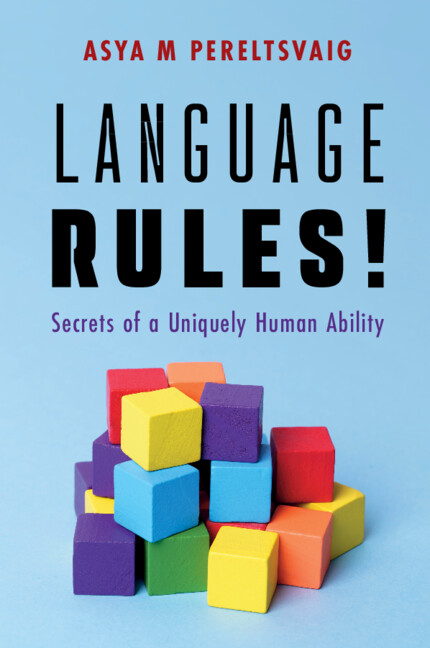
We all use language every day: not only to communicate thoughts and ideas to other people, but also for our internal monologue and, some might argue, for organizing thought. But what are the inner workings of human language and what makes it different from animal communication? Professional linguists study these questions in their finest detail, and this book presents the results of decades of linguistic scholarship for the general audience.
This book adopts the cognitive approach to language, which follows in the footsteps of Ferdinand de Saussure’s seminal work in the early 20th century and distinguishes between language (knowledge) and speech (behavior). Simply put, language is the knowledge stored in our minds that allows us to speak, whether by making noises and gestures for others to decode or by the internal monologue that runs in our heads. Unlike speech, which is linear as we pronounce sounds, words, and sentences one after another, language is organized not linearly but hierarchically — and that is the main tenet of this book.
As it introduces the reader to various sub-fields of linguistics, Language Rules! covers a wide range of topics, from poetry to language disorders, from sign languages to language genes, from differences and similarities across languages to scientists’ attempts to teach human language to apes. Separate chapters are dedicated to how language is processed in the mind, what brain structures are dedicated to language, and how languages are — and should be — taught in school in beyond.
The book is written in a fun and fascinating way that presupposes no previous knowledge of linguistics: when you have J.R.R. Tolkien, E. E. Cummings, and Eminem cited on the same page, you know the book will be an enjoyable read. In order not to overwhelm the reader with technicalities, several key language elements are explored throughout the book from different perspectives. One of them is the self-words (myself, himself, etc.) and the reflexive relation they encode: the reflexive relation (between I and myself, he and himself etc.) is explored at the sentence level, at the word level, and in a variety of the world’s language, including sign languages.
Another key aspect of Language Rules! is that it places linguistics on the same footing as other sciences: physics, chemistry, astronomy, biology and so on. The book starts with exploring how the popular view of language as a linear sequence of sounds and words is akin to the flat-Earthers’ views. Throughout the book, the reader will find a sprinkling of stories about how important scientific discoveries were made by Isaac Newton, Antoine Lavoisier, Urbain Le Verrier, and others — and important discoveries in linguistics can be, and were, made much in the same way. The last chapter shows how language teaching can be greatly improved — and both the student outcomes and their learning experiences can be enhanced — if professionals in applied language fields have a better understanding of language and adopt this more up-to-date, scientific approach to language.
So, if you are a curious and intelligent reader who wants to know more about language from the state-of-the-art perspective, this book is for you!

Asya M. Pereltsvaig has taught linguistics at Yale and Stanford, and has been teaching in several lifelong education programs since 2010. Her most recent book, Languages of the Wor...
View profile >Keep up with the latest from Cambridge University Press on our social media accounts.




Latest Comments
Have your say!