

Products and services


For decades, behavioural economics has transformed how we think about human decision-making. It showed that people are not the cold, hyper-rational optimisers imagined by classical economics. We rely on heuristics. We fear losses more than we value equivalent gains, we overvalue our own properties, we discount future rewards more than we should. And we have social preferences. We care about fairness and social welfare. These insights reshaped economics and influenced everything from public policy to marketing.
But there is a deeper problem.
Much of behavioural economics still assumes that what matters in a decision is, ultimately, the outcome: who gets what, how much is gained or lost, and with what probability. Even when the models become more psychologically realistic, they usually remain outcome-based. They still assume that utility depends on consequences alone.
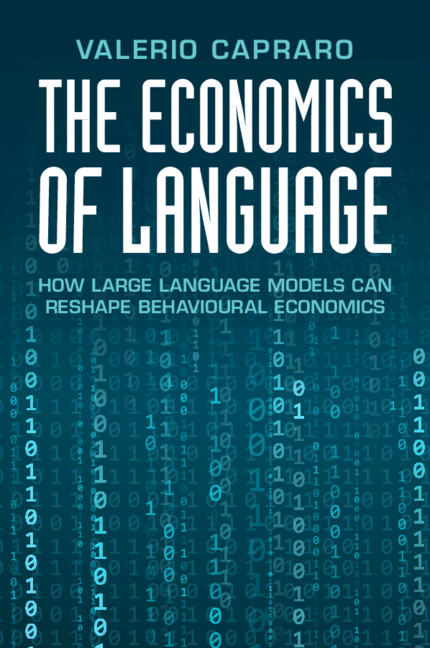
The book, The Economics of Language: How Large Language Models Can Reshape Behavioural Economics, argues that this assumption is too narrow. In many decisions, people do not respond only to outcomes. They also respond to how those outcomes are described.
This is not a minor detail. It is not noise. It is not something to be controlled away with supposedly neutral instructions. It is a constitutive part of human decision-making. Call a Prisoner’s Dilemma a “community game” and cooperation increases. Label a selfish act with morally softened language and people will become more selfish. Describe the same economic option using different words, and choices will change even when the monetary consequences remain identical. Language does not merely decorate decisions. It helps construct them.
That is why I argue that behavioural economics is undergoing a paradigm shift: from outcome-based preferences to language-based preferences.
This shift matters now more than ever because of large language models. LLMs are changing the environment in which decisions are made. Increasingly, people interact with AI systems when choosing what to buy, how to invest, what medical option to consider, or how to interpret a social situation. These interactions are fundamentally linguistic. If decision support is mediated by language, then any serious account of human behaviour must explain how language shapes utility.
At the same time, LLMs offer something economists have long lacked: a way to quantify aspects of language at scale. For a long time, one reason economists were wary of language effects was methodological. Words seemed too slippery, too qualitative, too hard to measure rigorously. That is no longer true.
The book explores how tools from sentiment analysis and LLM-based prompting can help measure the emotional and normative meaning of actions within contexts. It introduces the LENS model: linguistic content triggers Emotions and suggests Norms, which together influence Strategy. In this view, utility is not just about payoff. It is also about whether an action feels generous or selfish, fair or improper, admirable or shameful.
This does not mean abandoning behavioural economics. It means extending it. Behavioural economics began by revealing that human beings are not perfectly rational calculators. The next step may be to recognise that we are not just outcome-sensitive minds. We are language-sensitive minds.

Valerio Capraro is a professor in the Department of Psychology at the University of Milan Bicocca. He holds a Ph.D. in mathematics and studies human behaviour by combining mathemat...
View profile >Keep up with the latest from Cambridge University Press on our social media accounts.



Latest Comments
Have your say!