

Products and services


What can we learn about broad institutional formation from the experience of US environmental legislation?
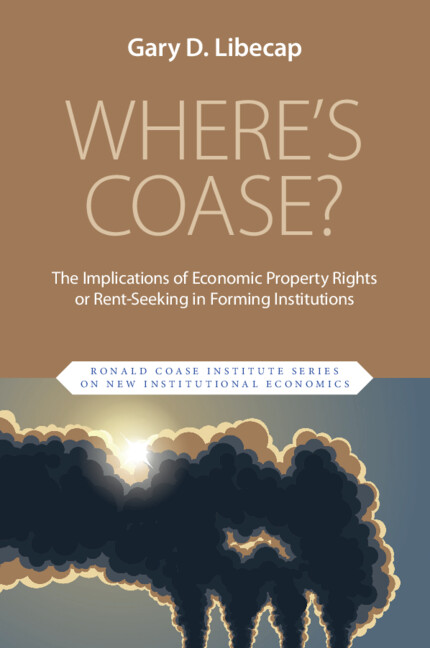
Despite providing public goods, environmental regulation is too costly, inequitable, and controversial. Why that is the case and what it suggests for general institutional change are cautionary lessons from the adoption of centralized prescriptive policies rather than decentralized markets to address major social problems.
Beginning with Ronald Coase’s 1960 classic article “The Problem of Social Cost,” there was an outpouring of research on property rights, governance, market institutions, and economic performance. Nobel Prizes were awarded to Coase (1991), Douglas North (1992), Oliver Williamson (2009), Elinor Ostrom (2009), Daron Acemoglu (2024), James Robinson (2024), and Simon Johnson (2024). Key advantages were lower transaction costs arising from economic property rights and related institutional formation to promote exchange, efficient organization, investment, and production. Even so, empirical adoption has been surprisingly mixed. While private actors use them in firm governance and contracts, the global acceptance of economic property rights and market principles in the political arena has been far more limited, at the expense of broader wellbeing. More narrowly, despite the work of Scott Gordon (1954) and Anthony Scott (1955) on the use of property rights to mitigate the race to fish and related stock depletion, only a few countries have adopted such arrangements, reducing the economic returns from the global fishery resource. Is this very narrow and disappointing record due to high transaction costs or is there something else inherent in the political process that impedes economic property rights and markets?
For insight, I examine Coase’s arguments for achieving transaction cost efficiencies in mitigating externalities as an alternative to centralized prescriptive regulation. Although Coase’s 1960 paper is one of the most widely cited works in economics, his framework has not been primary in any U.S. environmental law. As a result, the efficiency benefits, welfare improvements, and collaborative problem solving envisioned by Coase have not been achieved. Mitigation policies are politically controversial; overly costly on the margin; and costs and benefits are inequitably distributed.
While Coase and others focused on private efficiency gains within firms and markets, they left unexplored the role of political exchange and rent-seeking. Indeed, transaction cost economics has played a far lesser role in the political arena. In environmental legislation, rent-seeking behavior as described by Gordon Tullock (1967) and Anne Krueger (1974) displaces economic property rights and market exchange. The key agents are politicians, agency officials, and lobbyists from industry, labor unions, and environmental NGOs. As I describe, policy-based rents include pecuniary competitive advantages and importantly, nonpecuniary philosophically-desired goals, as well as campaign contributions, reelection support, agency mandates, and budgets. These returns are provided at private costs below what agents might have been willing to pay, generating rents, and are not easily competed away. I draw upon legislative histories, law reviews, and the relevant economics literature for three major US environmental laws: the Clean Air Act Amendments of 1970, 1977, and 1990; the Magnuson-Stevens Fishery Act of 1976; and the Endangered Species Act of 1973. I find no evidence that policymakers considered the comparative transaction costs of decentralized property rights and exchange versus centralized prescriptive approaches in crafting these laws. Had Coasean structures been the aim, they could have been implemented at least more generally than observed. Instead, political rent-seeking has molded externality regulation.
Broadly, the prevalence of rent-seeking in environmental legislation suggests why economic property rights and decentralized markets have been more restricted in general policy than their cost efficiencies and beneficial welfare potentials suggest.

Gary Libecap is Distinguished Professor in the Bren School of Environmental Science and Management and Economics Department at the University of California, Santa Barbara, and Rese...
View profile >Keep up with the latest from Cambridge University Press on our social media accounts.




Latest Comments
Have your say!