

Products and services


The aim of this book is to find some precision and a point of origin for the concept of capital and by doing that, therefore capitalism. It also challenges the merchant based London centric interpretation of the financial revolution, and argues that the socially and geographically broad based financial development it describes allowed industrialisation to happen. The term capitalism is often used too broadly; characterised as some kind of force whose power sweeps all before it. It also usually involves exploitation in the service of ever-expanding profits of a small elite who possessed capital. Most theories of the origins of both capital and capitalism stress the role of merchants trading over long distances -especially overseas merchants. My story is different. I argue that the use of capital developed as a social system. It is not a story confined to merchant elites, I instead argue that before anything called ‘capitalism’ could characterize a society it had to spread from merchant elites, and capital had to be understood, accepted, and used by most people in society. This again started in Italian cities such as Florence, Prato, Geona and Naples where local tradesmen and professional bankers created paper currency out of their capital, which could be used by ordinary people in their day to day transactions, but this development stalled there for various reasons. But the institutions and ideas were promoted by radicals in England during the civil war and republic (1642-59) and capital was turned into circulating paper currency in England, Scotland and the American colonies after 1680. It is a story of everyday life mostly in rural areas -not of high finance in London.
Most histories of capitalism assume that merchant capital eventually evolved into modern capital through banks such as the Banco di San Giorgio in Genoa or later the Bank of England which used merchant capital to invest in state debt, or the Bank of Amsterdam which invested in overseas trade. But, before it could significantly affect ways of doing business and relations of production, capital needed to progress beyond the high levels of the economy of merchants into wider society. The book also takes a significantly different approach from those which argue that Britain had better and more ‘representative’ institutions, which made financial capital more secure. Instead, it argues that it was legal flexibility which permitted local credit markets to be transformed through the use of new forms of savings and currency in an evolutionary way. Institutional flexibility was, in fact, more crucial than security. The creation of trust in new forms of capital was the decisive factor, and no new institution created trust on its own. This was a complex process which involved changes in theology, ethics and politics.
During the English civil war and commonwealth a group of radical utopian protestant thinkers centred around Samuel Hartlib, wanted to improve society by creating employment. To do this they proposed that by adopting paper currency to ordinary transactions in order to pay the wages of labourers and industrial workers, employment could be achieved by kickstarting economic growth. It is important to stress just how radical the nature of this program of liquidity creation was. The key to doing this was to create capital as a form of fixed value, and this was done primarily through ethics of the self which stressed self love, happiness, interest and savings. Then new institutions of accounting allowed profits to be saved and turned into circulating capital. This happened from roughly 1680 to 1760, and in England, this process was not undertaken by banks, as the civil war radicals had proposed, but was rather done privately though mortgage lending. At the same time in Scotland and the American colonies similar sorts of currencies were created by formal banking institutions in contrast to England. In economic terms this process not only succeeded in creating the liquidity to expand industrial production but it was also used for mass-consumption driven economic growth.
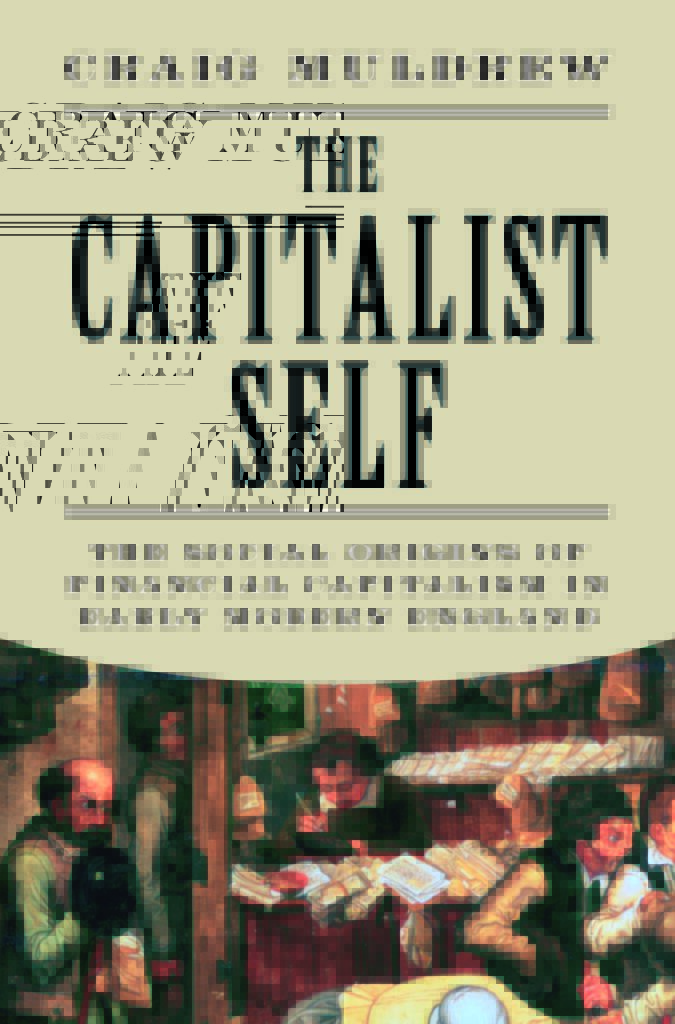

Craig Muldrew is Professor of Early Modern Social and Economic History at the University of Cambridge. He is the author of The Economy of Obligation (1998), which transformed the w...
View profile >Keep up with the latest from Cambridge University Press on our social media accounts.



Latest Comments
Have your say!