

Products and services


Departures
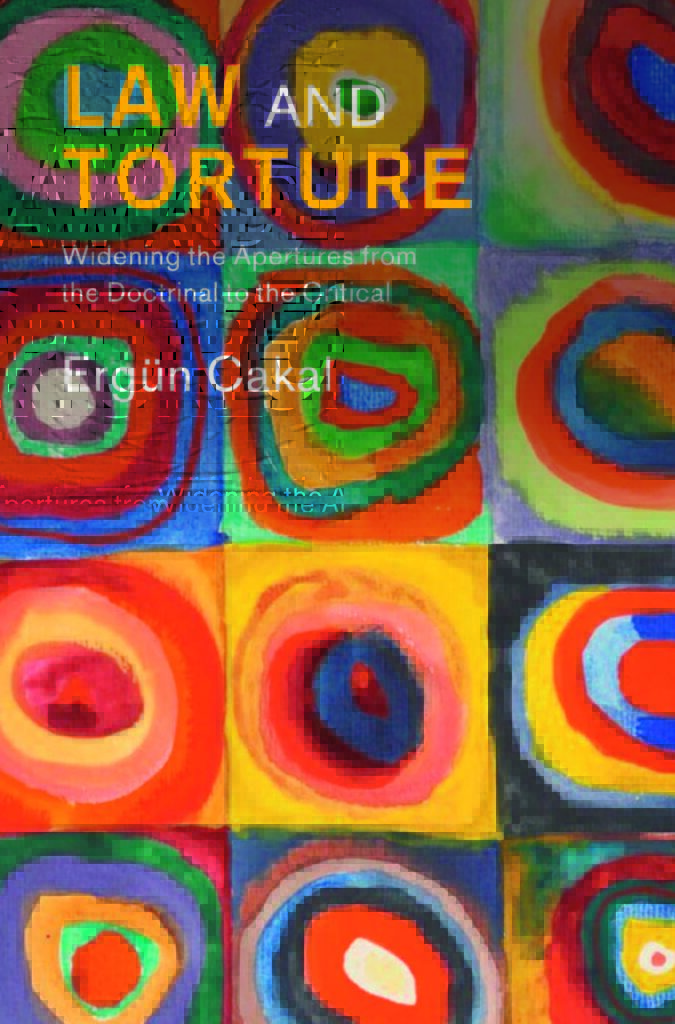
This book, at its core, is a renouncement of a belief system: doctrinal legal approaches to ‘law and torture’ research and practice. At the same time, it is articulation of new belief in disbelief: critique and the disciples of that disparate tradition. And it is a stringing together of all that which allowed me to frame provocative questions of doctrine – and all that didn’t quite find a home in my doctoral dissertation, because it was either somewhat distant or dangerous to defend in a traditional institution as a law school. Diplomatically put, this book is an attempt to enrich (though not as to correct) what I view as a relatively impoverished field of ‘law and torture’, namely dominant doctrinal legal approaches to torture’s adjudication (and by extension prevention). I say impoverished because legal practice and research remain mostly oblivious to the wider discussions around core questions of pain, the state, violence, responsibility, recognition etc.
Genesis
I was set up on this path engaging with the work of Vicky Canning, Toby Kelly, Andrew Jefferson, Steffen Jensen, Stanley Cohen, Lutz Oette, and Danielle Celermajer – the last of which propelled me to weigh in to the point where I use her recurring phrase ‘widening the apertures’ as my subtitle. Danielle’s discussion of her book ‘The Prevention of Torture: An Ecological Approach’ in Copenhagen more than five years ago defined a generative shift for me. I could plainly see how it split colleagues seated around me – some were not ready to receive her messages and grew grumpily defensive as others were remarking how it would’ve been the book that they would’ve written. The conversation grew as those in the Celermajer camp (particularly Andrew Jefferson and Tomas Max Martin) introduced me to what were to become intellectual muses including Veena Das, Austin Sarat, Thomas Mathiesen, Judith Butler, David Garland, Nils Christie, Scott Veitch, Emily Kidd White, Pierre Bourdieu, Talal Asad.
Provocations
I draw up five core provocations from these inspirations: (1) that legal doctrine dominates but disconnects important elements in understanding torture’s lifeworld; (2) that linear understandings of progress conceal failures of doctrine; (3) that human rights law has exceptionalised torture in a state-deferential manner; (4) that evidentiary discretion on the part of authoritative courts and committees has served this exceptionalisation; and (5) that potent clues are to be found in engaging with ideological and imaginational dimensions.
Those who’ve read my work before[1] might have charged me with not offering answers. And I’ve also been guilty of posing the question of utility to other colleagues. The value of any work like this (and what drives me) is (1) etching out a critical position for others to reflect on or reference and (2) to help myself and others to (perhaps riskily[2]) pick up and pick at their doxa.
Those who find all this too provocative can readily flick the channel to doctrine, enjoy the programming, the echo chamber, though the world burns. Law will surely not save us. In that sense this is a bleak book, for those more into their Bosch than their Botticelli.
[1] And this is its thorough reworking.
[2] I say risky not only because it might lead to disillusionment and putting oneself out of an otherwise rewarding job as a legal advisor but more importantly because it can feed state strategies against anti-torture work. A cross-cutting argument I shield myself with in the book is that that anti-torture work is unreflectingly state-deferential anyway.

Ergün Cakal is a researcher at the University of Copenhagen's and formerly a legal advisor at the Danish Institute Against Torture (DIGNITY). He has worked as an anti-torture lawy...
View profile >Keep up with the latest from Cambridge University Press on our social media accounts.




Latest Comments
Have your say!