

Products and services

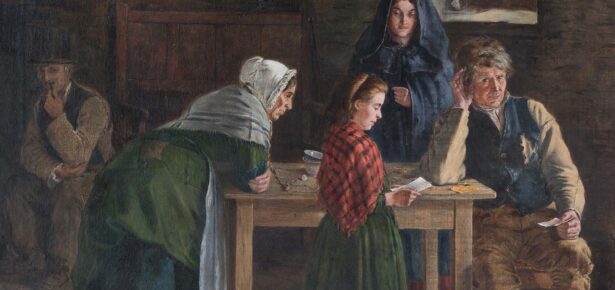
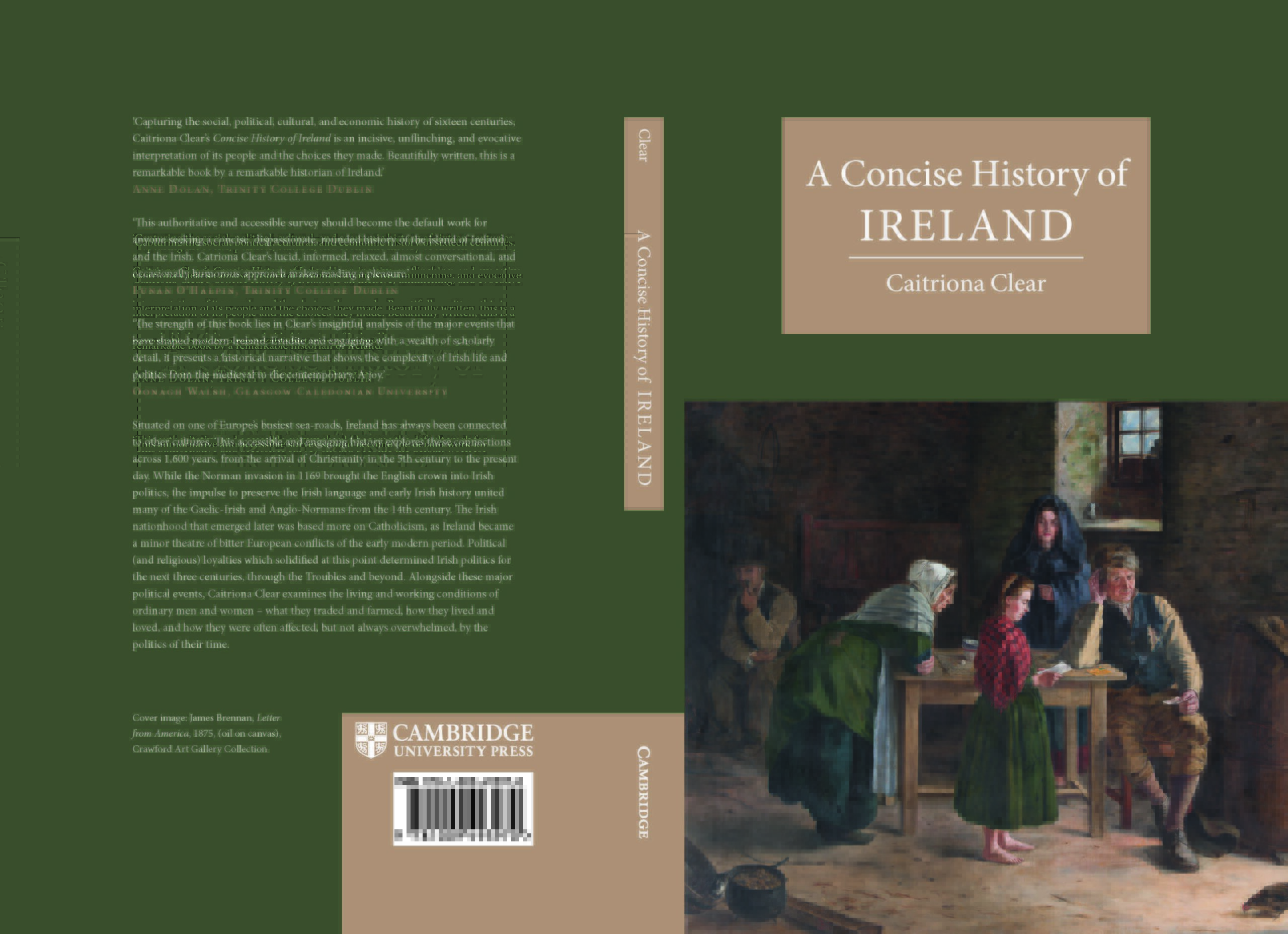
A girl of around 11 or 12 is reading out a letter to her attentive elders. Why did I pick James Brenan’s ‘News From America’ to illustrate a history of Ireland that spans sixteen centuries? Why not pick a ring fort, a round tower, a monastic ruin, a seventeenth-century battle scene, a graceful eighteenth-century public building, a tumble-down cabin, a tricolour?
I chose this painting firstly, because it illustrates Irish people’s ongoing connectedness with the outside world. Up to the late nineteenth century, the most efficient and capacious method of transport was by water, and the sea-roads which surround Ireland were always busy. Irish people were trading with Britain and Europe, from the Baltics to the Mediterranean, long before Patrick’s arrival in the fifth century. Later, links with Rome and European religious organizations gave many Irish people an additional reason to be either on the move, or receiving regular communications from those who were. This girl’s audience are only the latest in a long line of listeners.
I chose it secondly because it shows the interface between the written and the spoken or heard word. From the fifth century the Irish language began to be written down in the Latinised style, with left-to-right script, spaces between words and punctuation. Later, the English language would be written down too. Lawyers, scholars, poets and clerics, politicians, administrators and a small section of the leisured classes were the only literate people until the late eighteenth century, but the power of the written word was strong. Songs, stories, poems, prayers and genealogies which were passed on ó bhéal go béal (from mouth to mouth) as often as not, originated in print or script. The 17th and 18th-century Irish-language poets were literate in two, sometimes three languages, writing down the poems and songs which were then transmitted orally. The written and the oral were on an endless loop.
Thirdly, in this painting, although nineteenth-century Ireland had its share of traumas, all is calm. A hen (or is it a duck) has wandered in from outside. A man with a hat is puffing a pipe in the background. The younger woman (in black) has her eyes on her sewing or knitting, as she listens. There is a pot of potatoes in the foreground, and a large chest of meal just inside the front door. The house has thick walls, glass windows and a fireplace and chimney (just out of range). The girl is barefoot, but her elders, male and female, are well-shod and warmly-dressed. They are not rich but they are not poor, either. They are getting on with their lives.
Making a ‘scholar’ of the daughter is part of that getting on, and this is the fourth reason I chose this painting. Females were half of the Irish population over these centuries, though you wouldn’t always think it from reading some histories. Although slightly hidden in the sources, they are there if you look for them, and sometimes they even demonstrate agency and exercise authority, like this girl.

Caitriona Clear lectured in history at the University of Galway until her retirement. Her publications include Nuns in 19th-Century Ireland (1987), Women of the House in Ireland 19...
View profile >Keep up with the latest from Cambridge University Press on our social media accounts.


Latest Comments
Have your say!