

Products and services


What is the right thing to do? You probably find yourself asking this question quite often. Philosophers, both inside and outside academia, have pondered it by exploring its meaning and considering potential answers. To clarify, they have developed or imagined various scenarios that touch on different facets of human existence. Interestingly, the market is one of the least considered areas. Don’t misunderstand me—Business Ethics (BE) was originally created to address moral questions in economic issues. However, much of the BE literature appears focused on cases within firms, organizations, and companies. The market, a space where individuals produce and exchange goods and services, remains relatively overlooked. This may be because markets are often viewed as ‘morally free zones’ (Gauthier 1986; Bruni and Sugden 2008) where a system of incentives is “designed as if people were entirely motivated by narrow, selfish concerns and […] will be fundamentally amoral, ignoring rules, breaking agreements, and employing guile, manipulation, and deception if they see personal gain in doing so.” (Milgrom and Roberts 1992, 42) I believe this is not truly the case; moral questions are also relevant within free markets and are often raised by its participants. This is the starting point of my book.
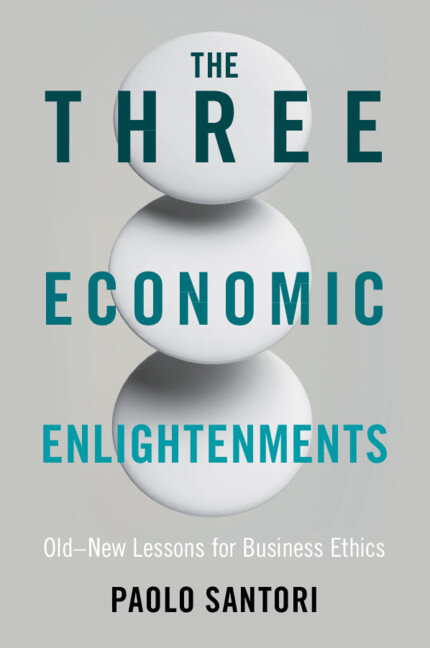
The Three Economic Enlightenments seeks to provide readers with a set of moral principles that can guide both personal and collective reflection among market participants on doing the right thing in market exchanges. Not that the menu offers just a few courses. In BE, we recognize that the morality of an action or decision can be assessed through its outcomes, the intentions behind it, the character of those involved, or how they care for one another. My book’s modest goal is to enrich normative ethical theories—such as consequentialism, deontology, virtue ethics, and care ethics—with three additional theories that base their moral principles on market exchanges between individuals. I have attempted to do this not by focusing on non-Western cultures, which is valuable in itself, but by examining the history of Western economic and philosophical ideas. History is like the roots of a tree; roots reveal not only the tree’s past but also its possible future. The roots I am exploring in my book originate from the European Enlightenment of the 18th century, specifically relating to three authors: Antonio Genovesi, Adam Smith, and Immanuel Kant. By interpretation, I have extracted three moral principles of economic agents that are still relevant in today’s moral reflections of market participants, i.e., Genovesi’s principle of mutual assistance, Smith’s principle of self-interest and non-tuism, and Kant’s duty of honoring the spirit of mutually beneficial contracts.
In the second part of the book, I apply these three moral principles to three case studies involving incomplete contracts—not just generic lab examples, but adaptations of stories shared with me by friends or family. I do this partly as an exercise to practice applying the principles (for example, to demonstrate that principles don’t always translate directly into actions, or that no single principle is always “right”), and partly because I believe in the universal value of stories, which—like in literature—are universal not because they lack details, but because everyone can connect with them.
References
Bruni, L., & Sugden, R. (2008). Fraternity: why the market need not be a morally free zone. Economics & Philosophy, 24(1), 35-64.
Gauthier, D. (1986). Morals by agreement. Oxford University Press.
Milgrom, P. R., & Roberts, J. (1992). Economics, organization and management. Prentice Hall.

Paolo Santori is an Assistant Professor in the Philosophy Department at Tilburg University, the Netherlands and the Chair of the Scientific Committee of the Economy of Francesco Fo...
View profile >Keep up with the latest from Cambridge University Press on our social media accounts.




Latest Comments
Have your say!