

Products and services


As the International Year of Quantum Science and Technology 2025 marks one hundred years of modern, quantum mechanics this reflection invites readers to look beyond the theory’s extraordinary successes and to consider how we understand, teach, and carry it forward into its next century.
When the United Nations proclaimed 2025 the International Year of Quantum Science and Technology (IYQ 2025), it did more than commemorate a scientific milestone. It implicitly acknowledged that quantum science has become one of the central pillars of modern civilization—scientifically, technologically, and economically.
One hundred years after the emergence of modern quantum mechanics, the theory stands unrivalled in predictive power. It describes the structure and behavior of atoms and molecules, explains radioactivity and the origin of stellar energy, and accounts for the evolution of the universe. It underlies technologies that define contemporary life, from semiconductors and lasers to medical imaging and precision metrology, and it fuels ambitious new efforts in quantum computing, information and sensing.
Yet the centennial invites a more demanding question than celebration alone allows: how well do we actually understand the theory that has transformed our world?
A theory that works—and a meaning that remains elusive
The extraordinary success of quantum mechanics is beyond dispute. What is far less settled is what the theory tells us about physical reality. A century after its formulation, there is still no consensus on some of its most basic questions: What is a quantum state? Is the wave function a physical entity or a calculational tool? What, if anything, “collapses” during measurement? Why do quantum particles have wavelike properties? How does entanglement come about? What becomes of causality and locality at the quantum level?
These are not marginal philosophical curiosities. They go to the heart of the theory itself. Recent surveys of the physics community confirm a striking fragmentation of views, even among leading researchers, with no single interpretation commanding widespread confidence. The persistence of this divide reveals a deeper issue: quantum mechanics is operationally powerful, yet remains conceptually problematic.
The IYQ 2025 has made this tension more visible—not least because quantum ideas are now being communicated far beyond the physics community. When conceptual ambiguity is left unexamined, it readily gives rise to confusion, mystification, and, in the public sphere, to pseudo-scientific narratives that borrow quantum language while abandoning scientific discipline altogether.
Why the centennial is an educational turning point
As quantum technologies move rapidly from research laboratories into industry and society, the way is quantum mechanics taught takes on renewed importance. Too often, students are trained to use the formalism efficiently while being quietly encouraged not to ask what it means. The message, implicit or explicit, is that conceptual clarity is either unattainable or irrelevant—as long as the calculations work.
This attitude may be expedient, but it comes at a cost. A scientific theory that cannot be discussed in physical terms risks becoming opaque even to its practitioners. The long-term vitality of quantum science depends not only on technical mastery, but on cultivating a generation of scientists willing to confront foundational questions with seriousness and intellectual rigor.
The centennial of quantum mechanics, marked globally by IYQ 2025, is therefore not only a celebration of past achievements. It is a call to rethink how we understand, teach, and ultimately extend the theory.
A physical approach to a century-old framework
This perspective has guided our work for many years and is the motivation behind Quantum Mechanics: A Physical Approach. Our aim has been to present quantum mechanics not as a closed system of rules, but as a coherent physical theory—one whose mathematical structure, empirical success, and conceptual meaning must, and can, be addressed together. One that allows us to understand the physics underlying quantum phenomena.
Written for upper-level undergraduate and graduate students, as well as for instructors, the book develops the Schrödinger and Heisenberg pictures on equal footing, with Dirac’s notation serving as a unifying framework. Throughout, we emphasize physical interpretation alongside formal development, and we situate key ideas within their historical context, reminding readers that quantum mechanics emerged through intense conceptual struggle—and that this struggle is not entirely over. Interested readers will find concrete answers that will help them gain a clearer picture of the quantum world and, therefore, of the physical world as a whole. It is a picture that we, as authors, have gained after conducting extensive research into the theory’s foundations and teaching many generations.
Exercises and examples are designed to encourage active engagement, while later chapters connect foundational concepts to modern developments, including entanglement, quantum statistics, field quantization, and relativistic extensions of the theory.
Beyond celebration
Quantum science continues to grow new branches, producing remarkable applications and unprecedented technological promise. But a flourishing tree depends on the health of its roots. Ignoring foundational questions does not make them disappear; it merely postpones the effort required to address them.
As the IYQ 2025 draws attention to both the power and the limits of current understanding, the centennial of quantum mechanics stands as both a triumph and a challenge. Education will play a decisive role in determining how that challenge is met.
Our hope is that Quantum Mechanics: A Physical Approach contributes to this moment by encouraging students and instructors alike to engage with quantum mechanics as both a functioning tool and an explainable—and perhaps transformable—theory as it enters its second century.
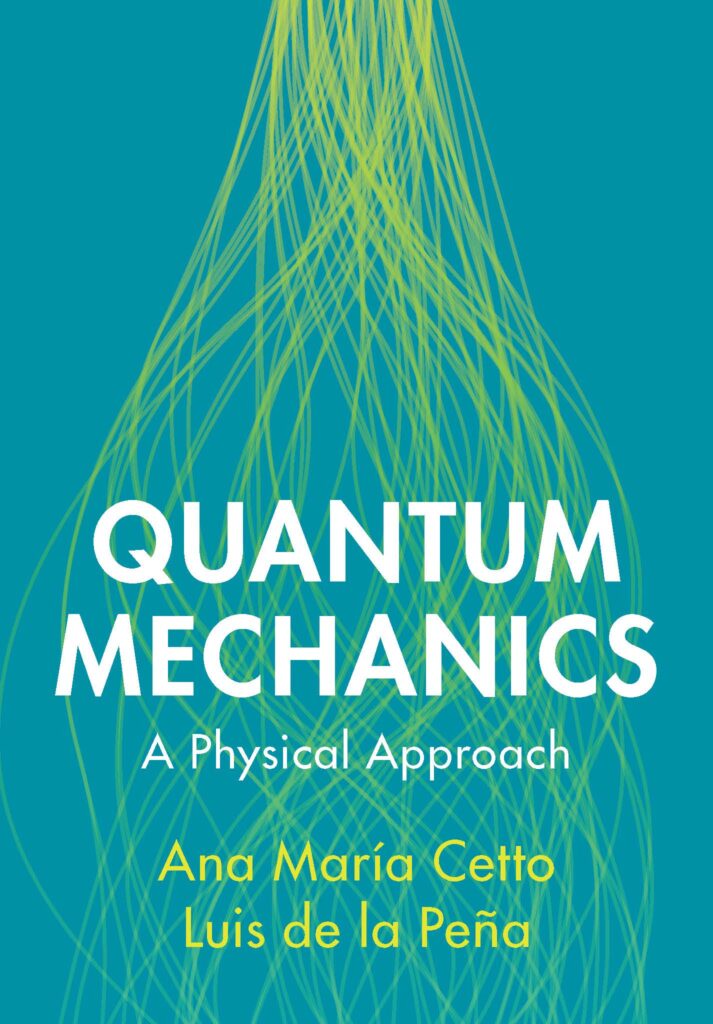
Title: Quantum Mechanics
A Physical Approach
Authors: Ana María Cetto and Luis de la Peña
ISBN: 9781009679626

Ana María Cetto is a Full Professor at the Instituto de Física, Universidad Nacional Autónoma de México. Specializing in the foundations of quantum physics, she has authored or...
View profile >Luis de la Peña holds the title of Professor Emeritus at the Instituto de Física, Universidad Nacional Autónoma de México. Specializing in the foundations of quantum theory and...
View profile >Keep up with the latest from Cambridge University Press on our social media accounts.



Latest Comments
Have your say!