

Products and services


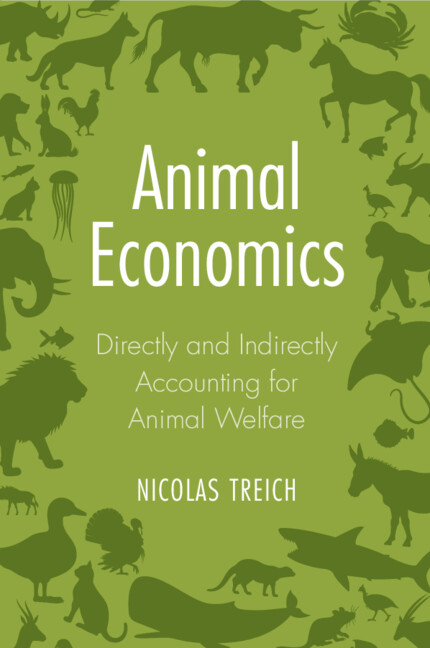
Animals are all around us. They give us food, clothing, and companionship. We use them for entertainment and research. And they are countless in the wild. Human activities affect them, often without us realizing it. Most importantly, many animals are sentient: they can feel pain and emotions. In other words, they can experience welfare.
Economics is a discipline focused on welfare—but on human welfare. In Animal Economics, I explore how to include animals and their welfare in economic analysis. This is not easy. We lack good tools to measure animal welfare, and there is a clear gap between what people say about caring for animals and how they actually behave in markets.
Fundamentally, animal welfare matters for two reasons. First, because animals value their own welfare. Second, because people care about animals. This book explores both perspectives: the direct and indirect approaches.
Under the direct approach, animal welfare is part of the social objective. Human impacts on animals can be seen as externalities. Standard economic tools, such as taxes or quality standards, can help design better policies affecting animals. This non-anthropocentric approach faces several challenges, discussed in the book: population ethics, the difficulty of comparing welfare across species, and the fact that animals have no political voice.
The indirect approach focuses on human concern for animals, but that concern is uneven. We like some animals and ignore others. We donate to shelters but overlook farm animals. We care about animals when we vote, but not when we shop. Drawing on economics, psychology, and other fields, I develop a behavioral theory of proanimal concerns to explain these patterns.
Animal Economics is for economists, students, researchers, and anyone interested in both animals and economics. It offers an introduction and an exploration of how economics can help design policies that take animals’ interests seriously. Importantly, it also highlights gaps in current knowledge, and thus key areas for future research.
The book is designed as a textbook. It can serve as supporting material for including a chapter on animals in broader courses in agricultural economics, environmental economics, welfare theory, benefit–cost analysis, conservation, corporate social responsibility, animal law, or animal ethics. Teaching materials are available on my webpage. While the book is mainly for an academic audience, its largely non-technical exposition makes it accessible to a wider range of readers. Overall, my hope is that it equips students, researchers, policymakers, and animal advocates with the tools to integrate animal welfare into economic thinking, and economic thinking into animal welfare protection.

Nicolas Treich is a research associate at the Toulouse School of Economics and National Research Institute for Agriculture, Food and the Environment (INRAE) in Toulouse, France. A ...
View profile >Keep up with the latest from Cambridge University Press on our social media accounts.



Latest Comments
Have your say!