

Products and services

The idea of the “Czech lands” has never been simple. These regions have carried many titles in various languages throughout history and sometimes held radically different meanings, including “the Czech Republic,” “Czechia,” “Bohemia, Moravia, and Silesia,” “Čechy, Morava, a Slezsko,” “Böhmen, Mähren, und Schlesien,” and “the Bohemian crownlands,” among other possibilities. In his landmark essay “Where is Central Europe?”, historian Lonnie Johnson explains that even seemingly neutral descriptions of geographic spaces like these are deeply subjective and instable, redefined time and time again by notions of religion, empire, monarchy, kingdom, ethnicity, race, region, sub-region, ordinal direction, nation, state, historical narratives, victimhood, belonging, “otherness,” culture, homogeny, democracy, exclusion, and genocide. And while this list is in no way exhaustive, its challenges are only intensified by the possibilities of combination and negation: notions of a multiethnic monarchy, for example, or heterogeneous post-communist nation. That is, Johnson reminds us that even at the level of geography, understandings of boundaries are not stable; instead, they are stories. And these stories, just like supposed “histories” themselves, are always cultivated, curated, and, by extension, incomplete and partial.
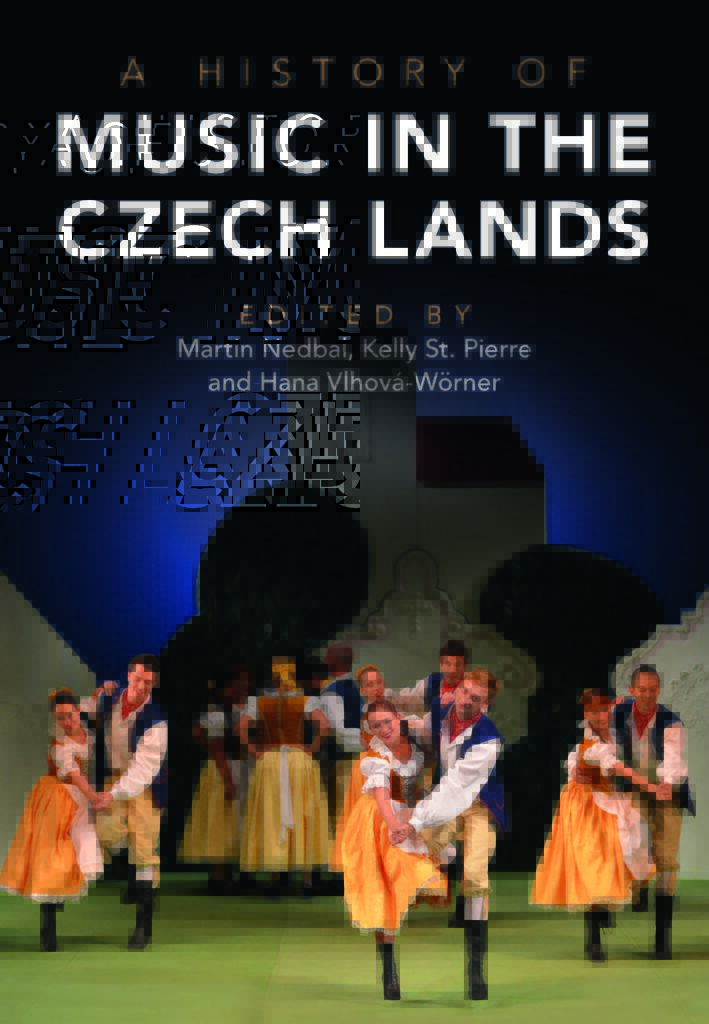
The Cambridge History of Music in the Czech Lands takes this instability as its starting point. Rather than proposing a singular definition of “Czech” music, this volume presents a collection of thirty-two essays by scholars based in the Czech Republic, North America, and Europe. Their approaches are varied, ranging from close readings of particular works to broader historical surveys, but together they illuminate the ways in which music in this region has always been entangled with shifting cultural, political, and social frameworks.
The volume covers a breadth of material. Early chapters address medieval chant and Hussite song, followed by Baroque sacred traditions that thrived under both local rulers and the Habsburg monarchy. A middle section presents the long nineteenth century as a period of musical institution-building, with opera houses, theaters, and choral societies, eventually negotiating tensions between German- and Czech-speaking communities. Later contributions turn to the twentieth century and today: the politics of music in the First Republic, the circumstances for cultural life under communism, and the flourishing of new genres in the post-1989 era. Alongside canonical figures like Bedřich Smetana, Antonín Dvořák, and Leoš Janáček, the book includes studies of Jewish synagogue repertoires, Romani popular bands, women composers, jazz and cabaret, rock and film music, and contemporary voices such as Sylvie Bodorová and Jakub Hrůša. This multiplicity makes the book the first English-language resource to encompass both the traditional canon and the newer subjects that have reshaped musicological inquiry in recent decades.
In a world where cultural boundaries remain under scrutiny, The Cambridge History of Music in the Czech Lands aims to honor multiple voices and narratives. Readers are invited into new beginnings: toward further research, open dialogues, and deeper engagement with cultural pasts in Central Europe. This volume will be invaluable for students and scholars of musicology, history, and Slavic studies, as well as performers and general readers interested in how music both reflects and complicates questions of identity. It offers not only a resource for research and teaching, but also a compelling introduction for anyone curious about the diverse musical traditions of Central Europe.
Keep up with the latest from Cambridge University Press on our social media accounts.


Latest Comments
Have your say!