

Products and services


The debate on the European Court of Human Rights is back – if it ever left in the first place. After a decade-long push to move toward increased subsidiarity, the most recent stage in the debate entails several states signing a letter to the Court complaining that its interpretation doesn’t allow the expulsion of criminal asylum seekers. In Switzerland, responding harshly to the judgment in KlimaSeniorinnen and recently in the UK, the campaign to abandon the Convention altogether has again re-emerged.
This is a deeply contested issue, where politicians and lawyers seem on occasion to live in different universes. Yet curiously, in this debate, both proponents of the Court as well as its critics share a very similar vision of the Convention’s history. It’s a story of the ‘rise and rise’ of the European Convention, which, after a slow start, took off to become one of the most important regional human rights systems in the world. The image conjured in this narrative is that of the Convention as ‘Sleeping Beauty’: passive and quiet until Prince Charming (the Court) steps in to wake her up, and living happily ever after.
Now, depending on one’s preference, this development is either criticised or defended. For critics, the story of the history of the Convention is that of a rude awakening. To stick to the image of a Sleeping Beauty, the prince overstepped quite some boundaries by kissing awake the princess via a line of progressive case law. In doing so, it turned the Convention into something the drafters never meant it to be, at the expense of democratic legislation. The kiss, in other words, was not consensual.
Coming out in defence of the Court, proponents have noted how the Court and Convention are the most tangible remnants of a post-war consensus to protect individual human rights against governmental intrusion. As a ‘beauty’, it is inherently worth defending. After a slow beginning, the prince breathed life into the Convention, and the princess and prince began their joyful time together as they brought civilisation to the states of Europe, in particular after the end of the Cold War. This story embraces the kiss of the prince as a necessary and logical prerequisite to live happily ever after.
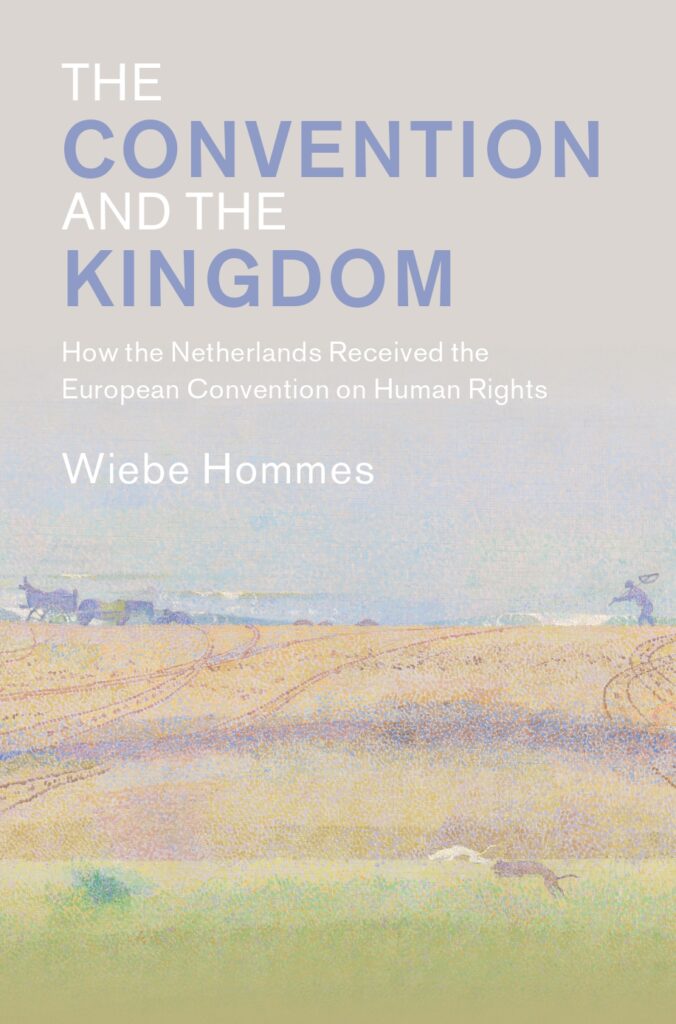
In my book, I argue this historical narrative is flawed and, as such, not a great basis on which to debate the Court’s current position. Based on an in-depth historical study of how the European Convention was received in the Kingdom of the Netherlands, I set out a more nuanced and diverse story. Most importantly, I note how the development of the Convention was never a top-down process in which the domestic context passively accepted it. Rather, it was a highly active development in which a variety of actors participated in a co-creation.
Several threads run through the work to highlight that. First, the Convention wasn’t necessarily a Beauty but fluent in meaning. It took on many different meanings in many different periods. Moreover, it entailed different promises to different people over time: there is, in other words, not one single Convention.
Second, the Court was an important actor by all means in its development, but the meaning and trajectory of the Convention was shaped by a myriad of others as well, from diplomats and lawyers to scholars and activists. In doing so, the book highlights not just new actors but also new perspectives. Crucially, it highlights an often forgotten notion, namely the fact that the Convention was never solely ‘European’- the Netherlands, for instance, was a colonial power with vast overseas possessions. As such, the struggle for the meaning of the Convention was intimately tied up with issues of colonialism, and its meaning was determined by actors from these ‘overseas territories’ as well. In the Netherlands, European human rights posed questions which affected the entire Kingdom, entailing human rights and European integration were a source of debate and contention in Indonesia, Suriname and the Caribbean islands. Moreover, those debates in turn had an effect on the functioning of human rights in the Netherlands. We cannot, therefore, understand the history of the Convention merely as ‘European’ history.
When it comes to the current pushback, the book ultimately highlights how the history of the Convention was distinctively not an elaborate heist, in which the Court jumped on unsuspecting states with new human rights demands. Instead, it showcases how governments have been involved every step of the way in that process. From supporting it in the mid-1970s to contesting it in the decades afterwards, they have exerted a constant influence on the shape of the Convention. The search for a balance between individual rights protection and the prerogatives of states, which the drafters found so precious, has never left the system, regardless of the far-reaching institutional reforms from the 1990s. To persist in the narrative of how the Court made the Convention against the wishes of the states into something they never desired is therefore not fully convincing.
This finding goes both ways, though. Aiming for a purely legalised European system free from political pressure would be equally unconvincing. After all, if governments speak critically of the Convention, this in itself is no cause for concern, nor is it a bad thing per se. Concern from the national capitals regarding the way European human rights develop has, after all, been a consistent element of the system ever since its inception.
Instead, we would do well to see the development of the Convention as one carried forward by a great multitude of actors in continuous co-creation. Its meaning is not solely dependent on what a single Court makes of it: it also depends on academics, commentators, and individual plaintiffs perceiving injustices. The consequence of this is that the history of the Convention was and remains distinctively open—a key lesson in moving forward.

Wiebe Hommes is Assistant Professor in European Law and Legal History at the University of Amsterdam. His research revolves around the history of human rights and European integrat...
View profile >Keep up with the latest from Cambridge University Press on our social media accounts.




Latest Comments
Have your say!