

Products and services


The Rosetta Stone is a famous stone artefact that was found in Rosetta in 1799 with inscriptions written on it in three different languages: Ancient Egyptian, Demotic and Ancient Greek. Given that Ancient Greek was well understood at the time, it helped deciphering the two other languages, most particularly Ancient Egyptian. Why do I tell this story? Because, in my book Statistical Mechanics for Physicists and Mathematicians, I propose the idea that Statistical Mechanics essentially plays the role of a “Rosetta Stone of Physics”: serving as a translation tool between different languages used to describe the same system. Viewed in that way, Statistical Mechanics is not just a ‘one way’ street explaining macroscopic phenomena from the bottom up, but rather a bi-directional mathematical device relating first a lexicon describing a system’s behaviour in terms of macroscopic observables to a set of possible microscopic models and, from there, relate these possible microscopic models back to relations between macroscopic observables.
The translation device approach proposed in the book necessitates to characterise the different lexicons we talk about as clearly as possible; hence the necessity on an emphasis on the mathematics. In physics, the two typical lexicons to be connected will be that of thermodynamics and that of (classical or quantum) Hamiltonian mechanics. The initial connection between the two is made via the theory of probability theory. This book therefore engages first with a quite in-depth exposition of Kolmogorov’s probability theory introducing some rarely discussed notions in physics courses such as sigma algebras, absolute continuity of a measure relative to another, or the moment problem. It then delves into Hamiltonian mechanics foregoing initially some simplified notations used in physics texts which may tend to, at times, make some discussions (for example of Hamiltonian flow or Liouville’s theorem) a bit confusing. Again, attempt at clarity is key in this book. Gibbs’ Statistical Mechanics, which combines probability theory with mechanics, is then introduced – as a standalone theory separate from thermodynamics – following in the footsteps of Gibbs’ original text from 1902. In that spirit, the book reintroduces Gibbs’ forgotten notions of generic versus specific phase states aiming at labelling different ways of proceeding to characterise states of systems of identical particles. These notions of generic and specific states are epistemic in essence (because they concern states to be used in statistical mechanics). This is quite different from the modern terms of distinguishable versus indistinguishable which are ultimately ontological in essence (they refer to a genuine ability to discriminate whether the particulate matter constituting a substance are distinguishable or not in some absolute sense). This has important consequences discussed in a later chapter on the resolution of the famous Gibbs paradox of mixing for which an original solution is proposed in the book.
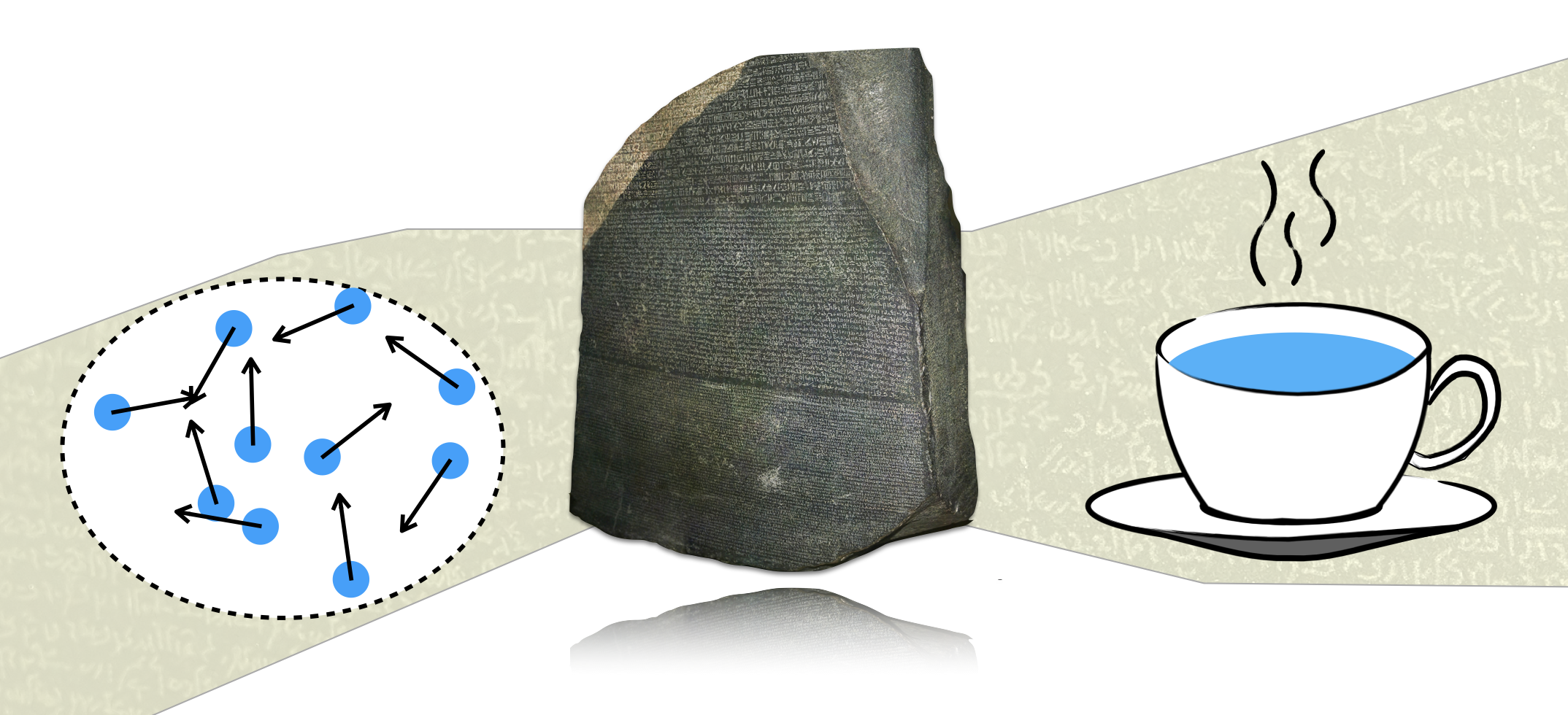
A detailed exposition of thermodynamic theory and its corresponding lexicon is then proposed in a subsequent chapter. Here the focus is again on clarity, verifiability and accountability. One particular reason why thermodynamics may be more confusing than other branches of physics, is because of the many different ways its laws are being presented in different texts over the last two hundred years or so, and sometimes in incompatible ways. Already in a 1958 article [3] Halliwell and Nyburg identified four distinct classes of statements of the 1st law of thermodynamics and four additional distinct classes of statements of the 2nd law of thermodynamics in the literature, and advocated for a radical change of presenting the material, which has never happened. The present book therefore goes at great lengths to only state laws that can be attributed to identifiable scholars, and their corresponding original texts. Hence, “the” first law is split into three separate statements, each addressing a different facet of energy transfer, and the 2nd law of thermodynamics is presented using the approach of Caratheodory. The third law of thermodynamics is also briefly discussed alongside some recent discussion about its potential non-necessity. The book introduces as well the notion of scaling map, i.e., the operation of varying a system’s size and capturing the effects of the such a transformation on other thermodynamic observables. The split of variables into the standard two categories called extensive and intensive emerges from the scaling map concept for certain systems, but not others (like self-gravitating systems). Finally, correspondences between thermodynamics and Gibbs’ statistical mechanics are drawn and its role as a two-way translation tool is then used to derive various results in classical statistical mechanics, e.g. deriving constitutive relations for gases or solids.
Upon comparing experimental data with some of the constitutive relations derived in classical statistical mechanics (e.g. the specific heat capacity of models of solids), some notable discrepancies can be noted. According to the Duhem-Quine thesis [4] it is actually impossible to unambiguously assert which part of the bundle of assumptions made in the derivation of constitutive laws is at fault. The book, follows the option that the theory (classical Hamiltonian Mechanics) being used to describe the mechanical state of the constituents of a substance may need to be replaced by Quantum Mechanics. In a somewhat operationalist sense, the notion of state in quantum mechanics is interpreted as a sort of preparation protocol which gives rise to repeatable expectation values of observables, themselves modelled as operators acting on a Hilbert space. Pure and mixed states are introduced, followed by quantum statistics mechanics. Correspondences with thermodynamics are further drawn and new constitutive relations can be derived. In particular, it is shown that keeping the same model (i.e. the same Hamiltonian) for a crystalline solid, but changing the theory from classical to quantum mechanics does provide a better agreement with experimental data for the behaviour of the specific heat capacity. The treatment of identical particles in quantum mechanics is introduced a priori by studying the linear representations of the permutation group: these include the so-called trivial representation, the signed representation, and mixtures of the two. Conventional quantum mechanics contends that only the trivial and signed representations are physically allowed, and they correspond respectively to the well-known bosonic and fermionic behaviours. Mixed representations may still exist either ‘really’ or as an effective tool of modelling, and the book mathematically represents their statistics via the generalised Gentile parastatistics. General results in statistical mechanics are then derived under the Gentile parastatistics, out of which the Fermi-Dirac and Bose-Einstein statistics arise as specific cases. Finally, the book finishes with an introductory discussion on phase transitions.
The book is aimed at upper undergraduate level (and beyond) in physics and mathematics and is meant to be a genuine introduction to the topic with no assumed prior exposure to the material, many worked examples, small exercises with solutions, and end-of-chapter exercises. It is not a mathematical text, and the keen mathematical readers will, I hope, take interest in making the proposed draft proofs more watertight. In the end, Statistical Mechanics for Physicists and Mathematicians aims at proposing an original take at introducing Statistical Mechanics without omitting its many conceptual and mathematical subtleties that are still the subject of open research questions to this day.
[1] https://www.britishmuseum.org/blog/everything-you-ever-wanted-know-about-rosetta-stone
[3] H. F. Halliwell and S. C. Nyburg, Statements of the first and second laws of thermodynamics, Science Progress (1933-), vol 46, pp. 450-458 (1958).
[4] https://en.wikipedia.org/wiki/Duhem%E2%80%93Quine_thesis
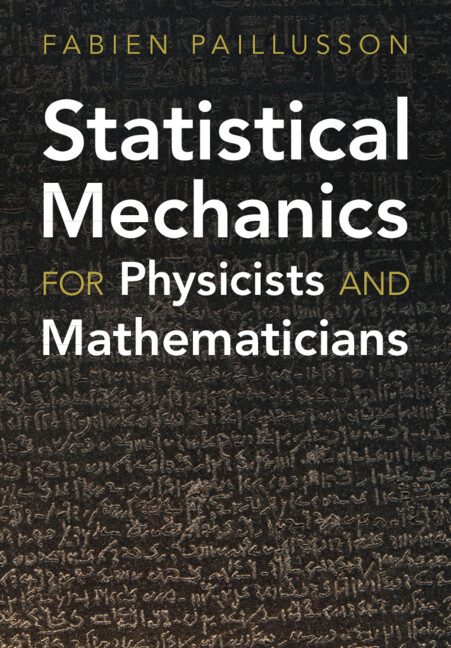
Title: Statistical Mechanics for Physicists and Mathematicians
ISBN: 9781009461634
Author: Fabien Paillusson

Fabien Paillusson is Associate Professor in the School of Engineering and Physical Sciences at the University of Lincoln. His research specialises in statistical mechanics and comp...
View profile >Keep up with the latest from Cambridge University Press on our social media accounts.




Latest Comments
Have your say!