

Products and services

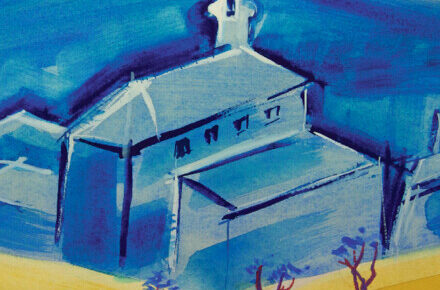
On our book’s cover stands a small church. Coloured in a blue that suggests the haze of a summer’s day, it is set against a yellow landscape dotted with vines. We chose this image partly for its aesthetic appeal, and partly because it was painted in the 1950s by Kurt Franke, the grandfather of one of the authors (you can see more of Franke’s paintings here).
This painting is of the church at Le Tholonet, near Aix-en-Provence. As it happens, this church is a modern construction from the eighteenth century, but the painting stands for the thousands of local churches that dotted the landscape of the Latin West by the tenth century. Some of these churches are known from passing references in legal records, others from archaeological investigation, but we also have a few early lists, such as one from Autun in Burgundy, compiled around 1000, which names 144 churches in the diocese (a map of them is provided in our book). Most such churches have since been rebuilt and enlarged or, occasionally, demolished, but they represented a major feature of the landscape at the time. In a rural age, it was the religious activities carried out in and around them that represented Christianity for the general population.
What, though, about the people who staffed all these churches? What about the priests who were needed inside them to sing Mass, to dispense baptism and to preach to the community, and outside them to anoint the sick? These men have not featured prominently in historical discussions of the period. When historians have discussed local churches, they have tended to focus on questions of spatiality – the emergence of ‘the parish’ with its boundaries – or on the legal status of the buildings – the concept of the ‘proprietary church’ – or on the representations of these priests in elite debates, where they feature almost as stick figures: uneducated, married farmers, hardly distinguishable from their lay neighbours. Like the painting of Le Tholonet, the ecclesial landscape of the tenth century has tended to be sparsely populated.
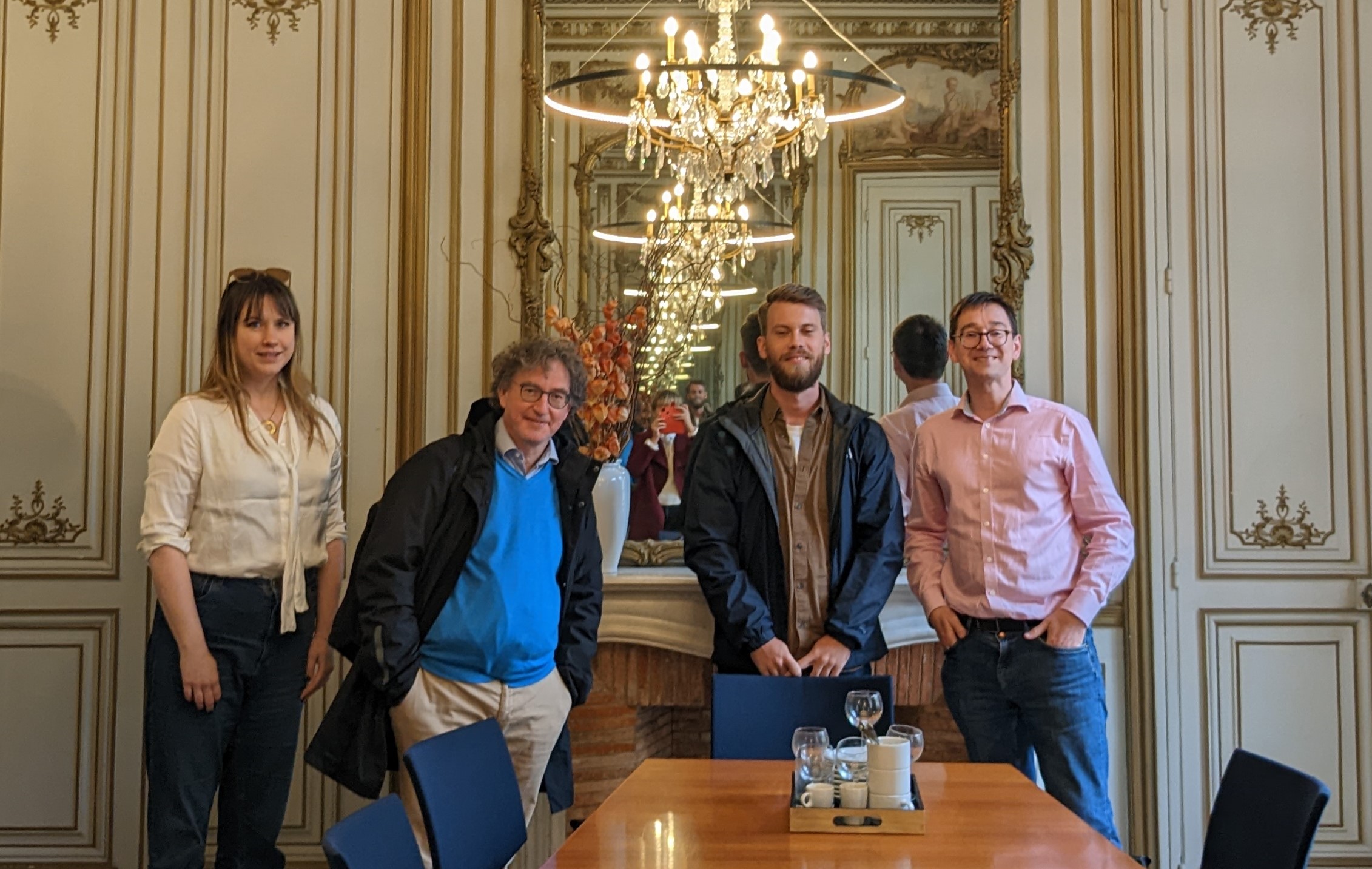
The authors in the Institut historique allemand, Paris.
The chief aim of our book is, then, to people the landscape on its cover: to put the local priest – or more accurately, the tens of thousands of local priests active in this period – back into the picture. Our geographical focus in the lands of the former Carolingian empire, since our work grows out of (and is indebted to) earlier work on local priests within that empire.
We proceed in four ways. We look at the property owned by these priests, who sometimes controlled sizable portfolios, and were by no means all at the edge of destitution. We investigate their kinship connections, including their wives but also their wider family, such as their parents and siblings. We re-examine the evidence for the diocesan synod, treating it as a moment when these geographically isolated priests met one another, and considering what they might have heard, learned and experienced. And we look at new techniques devised by bishops to try to keep these priests under control, notably the so-called Sendgericht or travelling episcopal court.
Throughout our research, we drew on the wisdom and advice of our ‘advisory board’, Julia Barrow and Carine van Rhijn, and the assistance of Marlene Wessel, and met regularly online and in person (our thanks to the German Historical Institute in London and the Institute historique allemand in Paris for hosting our group). We published some aspects of our findings in the journal Frühmittelalterliche Studien. And we posted regularly on our “Priest of the Month” blog, where you can find out more about some of the cases that made it into our book, and some that didn’t.
Our aim in this book is not just to shed light on a neglected group, though we hope we have done that. Rather, we hope also to provide empirical evidence to challenge the often rather abstract notion of the tenth century as a moment ‘between reforms’, caught between the Carolingians and the papacy of Gregory VII. Our local priests were not dissolute figures in need of Gregory VII’s stern hand; nor, however, were they identikit clones of the priests promoted and regulated by the Carolingian church. We show how this crucial dimension of institutional Christianity was evolving and changing, in interaction with the wider secular world, in its own distinctive rhythm. One of the motors of change was, of course, the ideological preoccupations of the elite, but we uncover the importance of the room for manoeuvre of the priests themselves, as their numbers steadily grew.
For this reason, we believe our book will be of interest not only to those concerned with early medieval local society and with the ongoing debates about Church Reform, but also to historians of the central Middle Ages – of the twelfth and thirteenth centuries, when the ‘parish’ was fully elaborated in the Latin West – who wish to see from where the arrangements they study had come. However, thanks to public funding from the UK’s AHRC and Germany’s DFG, who jointly sponsored our work, our book is available for free in open access, so it’s open for anyone, anywhere, to read it and see what they think for themselves.

Bastiaan Waagmeester is a postdoctoral researcher at the Freie Universität Berlin. His current research focuses on medieval written culture. His monograph Pastoral Works: Priests,...
View profile >Steffen Patzold is Professor of History at the University of Tübingen. His books include Episcopus (2008) and Presbyter (2020). He is a member of the Heidelberg Academy of Science...
View profile >Alice Hicklin is a postdoctoral research associate at King's College London. Her current research focuses on the social and economic world of northern French poet-composers, viewed...
View profile >
After an MPhil in Birmingham and a PhD in Cambridge, which included a spell at the University of Paris (Panthéon-Sorbonne) as a visiting student, Charles spent a year as a researc...
View profile >Keep up with the latest from Cambridge University Press on our social media accounts.



Latest Comments
Have your say!