

Products and services


On February 24 of 1920, the National Socialist German Workers’ Party (you know, the Nazis) issued their first party platform. Their demands are mostly what you would expect—conquering the greater German homeland, expelling foreigners, denaturalizing Jews. But point 19 of the manifesto goes in what might seem like an unexpected direction. The Nazis demanded “the replacement of Roman law, which supports a materialistic world order, with a German common law” (Wir fordern Ersatz für das der materialistischen Weltordnung dienende römische Recht durch ein deutsches Gemeinrecht). Why did the Nazis care so much about Roman law, and why should we?
As for the first question, Hitler found Roman law offensive because it stood in the way of fascist dictatorship. Germany, like other European nations, had adopted a highly technical statute law founded on Roman models. This law had many of the features (like autonomous courts and prospective rulemaking) that we now associate with Roman legal order, and these features diluted the pure spirit of the German Volk.
The funny thing is, those features of Roman legal order are shockingly hard to find in the Roman empire itself. Imperial Rome was a violent monarchy, governed by a parade of children, madmen, and despots—how did this chaotic, unstructured politic generate the law-codes that later generations have taken as instruction manuals for technocracy?
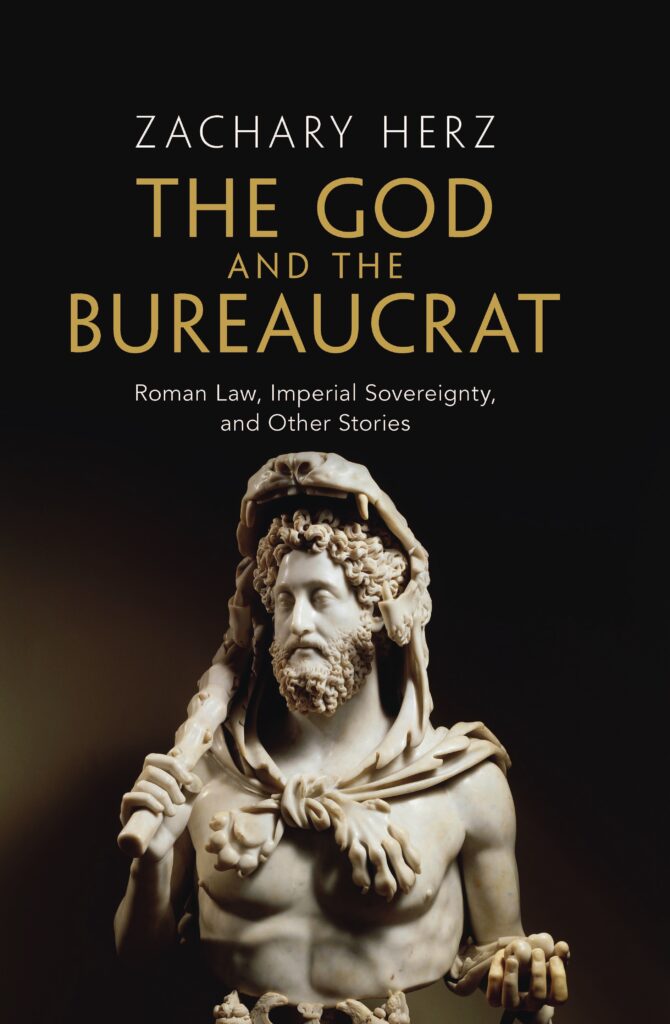
My new book, The God and the Bureaucrat: Roman Law, Imperial Sovereignty, and Other Stories, resolves the paradox by taking Roman law seriously as an imaginative endeavor. The Roman empire was a scary place, and people living there often wanted to see their world as something fairer and safer than it was. Law, which describes how people might solve their problems under ideal conditions, offered a language in which people could hope. Scholars, bureaucrats, and even emperors used the structure of legal writing to dream of legal order.
What makes Roman law so extraordinary is that those dreams came true. Later generations saw the rulebound society of Roman legal writing and took it as real; when they rebuilt their states along Classical Roman lines, they built a legality that had never quite existed before, and turned the ideal theory of legal scholars into something almost like the rule of law. This was the thing the Nazis hated, and the thing that historical tradition had trained them to see in Roman legal texts; in reality, this legalism emerged from the complex negotiations of frightened people trying to stay alive in a hostile state.
That is, I suppose, why we ought to care about Roman law. The Roman legal corpus is mind-numbing. It is silly, and technical, and absolutely bone dry. It offers none of the engagement, or excitement, or emotional thrust that Hitler wanted for his state and that many of us see in our politics today. Roman law is boring, but that boredom hides ideals that people fought and died for. Roman law shows us how a boring, liberal state might be invented, and what that state might do for people who badly need it.

Zachary Herz is Assistant Professor of Classics at the University of Colorado, Boulder. His research employs legal theory and methodology to better understand the distinctive role ...
View profile >Keep up with the latest from Cambridge University Press on our social media accounts.




Latest Comments
Have your say!