

Products and services


What was your very first “real” job? Maybe it came after high school or college, or maybe it came long before that. Maybe it aligned with your academic degree or credentials exactly, or, perhaps, it looked nothing like the work for which you thought you were preparing. For many of us, the transition into the workforce can be marked by uncertainty and awkwardness as well as exhilaration and discovery. Often, we don’t land our “dream job,” we may, in fact, simply land a job––however random or unexpected or even less-than-desirable it might be. And, from that imperfect starting point, our career takes shape.
Our new book, From First Job to Career (Cambridge University Press, 2025), was born out of that messy, formative workforce transition. The text is a collection of 62 first-job stories shared by generous people representing a wide range of industries, educational backgrounds, and life circumstances. Paired with a comprehensive review of research in vocational psychology and career counseling, the book offers both narrative inspiration and practical guidance for anyone navigating the early stages of their career (and/or helping others do so).
Rethinking Career Advice: From Linear Paths to Lived Experience
Too often, career guidance may offered in tidy formulas: follow your passion, climb the ladder, stick to the plan. But the reality for hosts of folks is much more complicated. Via our in-depth research for From First Job to Career and through the stories shared with us, we found that the journey from education or credentialing to employment is rarely linear––and we also found that that’s not a bad thing!
“Wyatt”––who kindly shared her story in the book––offered that they started as a food runner before becoming a bank loan officer. David took a job outside their field just to pay the bills and discovered a passion they hadn’t considered. A few of the folks who shared their voices in the book reinvented themselves after setbacks; others entered the workforce later in life or after major personal transitions. Some folks experienced discrimination and othering, some relied on family networks, and some simply took the first opportunity that came along. But all found ways to move from that first job toward meaningful work that spoke to their purpose and interests.
What the stories in From First Job to Career illustrate is that career development is not just about making the “right” choice. Career development is also about navigating change, managing expectations, recovering from disappointment, and recognizing and seizing opportunity––sometimes in unlikely places.
Stories with Substance: A Research-Informed Approach
While storytelling is at the heart of the book, From First Job to Career is also grounded in research. In Part I, we explore the history and evolution of career guidance, from the early 20th-century work of Frank Parsons to contemporary models that emphasize adaptability, identity, and intersectionality. We draw on frameworks such as Holland’s RIASEC model, Super’s Life-Span Life-Space Theory, the Theory of Work Adjustment, the Psychology of Working Theory, and more. We also examine critical limitations of traditional career development models, especially with respect to the underrepresentation of perspectives from minoritized, non-Western, and economically marginalized communities.
Part III of the book reflects on the themes that emerged across the 62 narratives such as risk-taking, resilience, identity, and career agility, and it situates these themes in praxis via the presentation of reflection prompts, career resources, and self-assessment tools for career searchers and those supporting them. Whether you’re a job seeker, a career coach, or an educator, From First Job to Career offers both the lived experience and the evidence base to support deeper, more thoughtful conversations about the world of work.
Why Stories Matter More Than Soundbites
We were inspired to write From First Job to Career in part by Studs Terkel’s Working, an oral history of people talking candidly about their jobs and what those jobs mean to them. In today’s world of short-form advice and social media hustle culture, we wanted to reintroduce the long-form, messy, personal career story––not polished résumés, but vulnerable, real accounts of success, productive failure, reinvention, and growth.
The generous folks who shared their stories with us for the text include recent college graduates, career changers, military veterans, parents returning to the workforce, first-generation professionals, and lifelong public servants. Their jobs span industries such as technology, finance, education, hospitality, healthcare, the arts, and the nonprofit sector, and, as individuals, reflect a wide range of backgrounds, identities, and geographies. Together, the narratives shared offer a collective wisdom that no career manual or algorithm can fully replicate.
The stories in From First Job to Career invite readers to ask: What counts as a “good” job? Whose voices are heard in our definitions of success? And how can we better support people through the vulnerable, high-stakes transition into the world of work?
Who the Book Is For
From First Job to Career is for job-seekers of all ages, whether you’re just entering the workforce, returning after a break, or navigating a mid-career pivot. It’s also for the mentors, counselors, educators, and family members who support job-seekers, especially during periods of transition or self-doubt.
We designed the book to be readable and accessible without sacrificing depth. Academic readers will appreciate the engagement with contemporary theory and critique, while general audiences will find the stories both illuminating and reassuring.
We also envision From First Job to Career being used in career counseling courses, vocational psychology classes, and university career centers. The reflection prompts and resource tables in Part III are classroom-ready, while the narratives in Part II can serve as case studies, conversation starters, or inspiration for writing assignments and group discussions.
Final Thoughts
The transition from first job to career is not just a logistical challenge, it’s an emotional and developmental one. It involves uncertainty, identity negotiation, and often a redefinition of what success means. We hope that From First Job to Career offers readers both comfort and clarity as they navigate that journey, and that the text helps build a more empathetic, inclusive, and realistic understanding of what it means to work.
To learn more or to order the book, visit Cambridge University Press’s website.
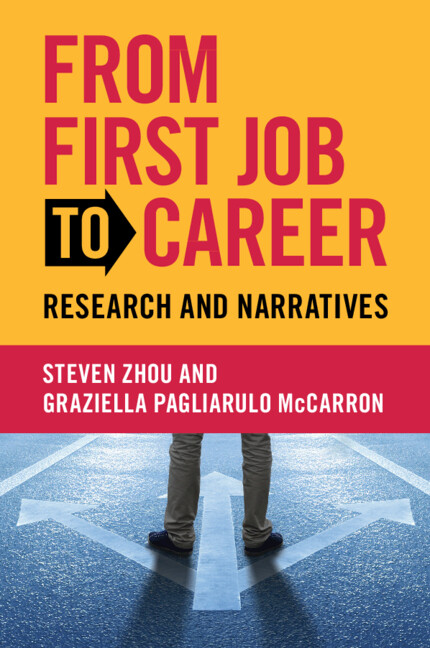
Title: From First Job to Career
ISBN: 9781009376976
Authors: Steven Zhou and Graziella Pagliarulo McCarron

Graziella Pagliarulo McCarron, Ph.D. is an Associate Professor of Leadership Studies and a Higher Education program faculty member at George Mason University. As a scholar-practiti...
View profile >Stephen Zhou is an assistant professor of psychology at Claremont McKenna College, where he researches and teaches on quantitative methods, leadership studies, and careers and voca...
View profile >Keep up with the latest from Cambridge University Press on our social media accounts.




Latest Comments
Have your say!