

Products and services



Slavery was an inextricable part of Christianity from its origins. Within the earliest gatherings of Jesus-followers in the eastern Mediterranean, enslaved persons and enslavers read sacred texts and participated in communal meals. Enslaved persons themselves, as recent research has shown, were responsible for the physical composition of New Testament literature.
Slavery, however, did not only affect the material and social lives of the earliest Jesus-followers; it also conditioned the development of their theologies and ethics. Ancient Christians lived in a world in which slavery was not only a ubiquitous socioeconomic phenomenon among humans, but was also a system of domination and exploitation in which the gods participated. Apollo, Zeus, Cybele, the Mother of the Gods, and Yahweh (among many, many others) all participated in the slave economy, legally owning enslaved persons and deploying them to accomplish a range of tasks.
Living in a world where gods could enslave humans influenced how many ancient Christians conceptualized their own relationship to God in the New Testament and other early Christian literature. We can see examples of Jesus-followers thinking at the nexus of slavery and theology, for example, in the apostle Paul’s letters to various Christian communities. In 1 Corinthians 7, Paul addresses enslaved persons in Corinth in a famously convoluted and difficult-to-interpret passage. In doing so, though, he claims that whoever was enslaved when they became a Jesus-follower now “belongs to the Enslaver” (the Greek term kurios is often translated as “Lord,” but is the same word that refers to enslavers). Free people, on the other hand, “belong to Christ” according to Paul, since everyone was “bought for a price” (1 Cor 7:22–73). Note that, no matter if someone in Corinth was free or enslaved when they began to follow Jesus, Paul claims that they have been purchased and are no longer their own; everyone is commodified and transferred as property as part of a slave economy that stretches to the heavens.
God, Slavery, and Early Christianity: Divine Possession and Ethics in the Shepherd of Hermas explores how Christian literature in the first and second centuries CE conceptualized God as an enslaved and believers as God’s enslaved persons. By focusing on one very popular Christian text, the Shepherd of Hermas, I make the case that some ancient Christians developed complex logics and mechanisms by which to explain how enslavement to God worked-both practically and theologically.
The Shepherd of Hermas: an Early Christian Case Study
The Shepherd of Hermas fascinated me in graduate school because it felt like a bit of an anomaly. Spanning over 114 chapters, this text was written in the late first or early second century CE and was attributed to an enslaved or formerly enslaved man named Hermas, who purportedly lived somewhere between Rome and Naples. In the Shepherd, Hermas has multiple encounters with two divine interlocutors-the Assembly (Ekklesia, which also means “Church”) and an angel called the Shepherd-who offer him visions, ethical commandments, and parabolic instruction. While most people today have not heard of or read the Shepherd, it was supremely popular among early Christians. It was read in churches in the fourth and fifth centuries, may have been included in some late ancient Bibles, and has more surviving manuscripts from antiquity than most texts that are now part of the New Testament.
My book emerged from this dissonance: why did ancient Christians read and appreciate this text so much, while scholars of early Christianity today tend to avoid engaging with it because of its long-winded, moralizing passages? What were they gaining from the Shepherd? I found the answer in its representation of enslavement to God.
Enslavement to God in Early Christianity
The Shepherd, I argue, speaks openly (compared to some other early Christian literature) about the way that enslavement to God happens and the effects that Hermas expects that it should have on a person’s piety and ethics. Certain traits that are especially associated with slavery-traits like usefulness, loyalty, commodification as property, and performing menial labor-are depicted by the Shepherd as expressions of piety.
But how does this enslavement happen? The Shepherd suggests that God sends the holy spirit into the human body to surveil and delineate proper emotions and actions for God’s enslaved persons. Before the formalization of the Holy Spirit as a member of the Trinity in Christian theology, some early Christians thought that the holy spirit was just like any other spirit (in Greek, pneuma): it took up physical space in the body and worked to animate the body in particular ways. Spirit possession and slavery were two sides of the same coin in the Shepherd’s moral imagination, since it involved one entity controlling and affecting the actions of another.
Understanding how and why early Christians thought that slavery to God was a meaningful way to describe their relationship to the divine is important because the entanglement of slavery and Christianity did not end with the abolition of the Transatlantic slave trade. Slavery lives on in Christian vocabulary, often in euphemized ways-serving God, having a servant heart, or referring to God or Jesus as Lord. This vocabulary still shapes the kinds of behaviors towards which Christians aspire, and subtly retains the idea that slavery as an acceptable relationship between humans and the divine.
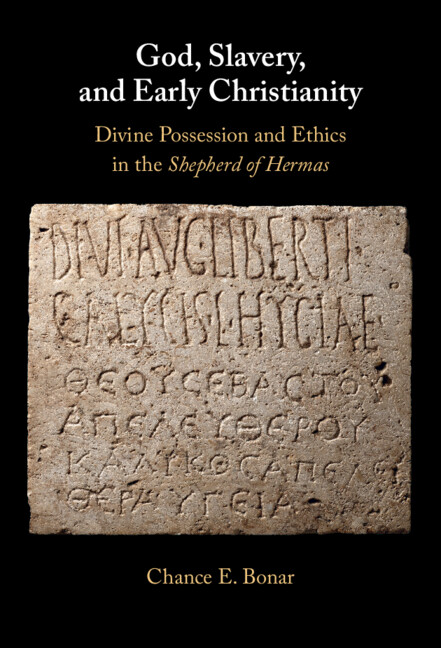
God, Slavery, and Early Christianity
by Chance E. Bonar
Keep up with the latest from Cambridge University Press on our social media accounts.



Latest Comments
Have your say!