Number of articles per page:
-
Jan Plamper
I had done twenty-odd discussion events around my book in East Germany, but this was something else. “If they start disturbing, or if things turn violent, just push the red button and the police will come,” said the representative of the local antiracist citizen group that had invited me to Chemnitz, pointing to a contraption […]
Read More
-
Monika Amsler
Have you ever wondered how ancient data management worked? How ancient authors of books that we would term encyclopedic managed their data, for example? Truth is, we don’t know. No ancient author bothered to explain their data management for posterity. Since ancient authors are otherwise quite boastful about even minor innovations, it seems that the […]
Read More
-
Sameen Siddiqi, Awad Mataria, Katherine D. Rouleau, Meesha Iqbal
How did the idea come about? It is widely known that well-performing health systems are critical for advancing universal health coverage (UHC), enhancing global health security, and achieving health-related Sustainable Development Goals (SDGs). Despite their uncontested role, many countries, especially low-and middle-income countries (L&MICs) struggle to strengthen health systems to improve population health and boost […]
Read More
-
Emanuel Kulczycki
Rudolf Weigl, a Polish biologist who invented the first effective vaccine against typhus, called a practice of publishing many papers a ‘duck shit’: just as ducks leave a lot of traces while walking about in the yard, scientists hastily publish articles with partial results that are the product of undeveloped thought. This is one of the unfortunate outcomes of the evaluation game in today’s science, where researchers attempt to follow various evaluation rules and meet metrics-based expectations.
Read More
-
Andrew Phemister
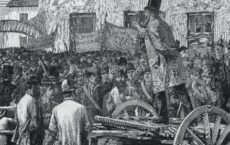
‘The death knell of thralldom’ ran the newspaper headline. A grand claim, certainly, but one that many reading it in 1880 believed could be true. For these American radicals, the fact that this ‘death knell’ was ‘sounding from the little Isle of Erin’ was simply a historical quirk, for its implications were universal. As one […]
Read More
-
Susan M. Wolfe, Ann Webb Price
When we first met many, many conferences ago, my writing partner discovered we had a lot in common. Beyond some similar childhood experiences, we are both community psychologists and both enjoy working with community coalitions and mission-driven nonprofits. We practice in communities, often as evaluators.
Read More
-
Roel Snieder, Cortney Holles, Qin Zhu, Cynthia James
In the book The Joy of Science, Seven Principles for Scientists Seeking Happiness, Harmony, and Success, one of us with co-author Jen Schneider discuss the pressures that academic faculty operate under. As an antidote to these pressures, Snieder and Schneider introduce practices of self-care for faculty that increase wellbeing. They also propose habits that allow […]
Read More
-
Wendy E. Parmet
More than three years after the start of the COVID-19 pandemic, the United States is an unhealthy country. During the pandemic, the United States lost more people per capita to COVID-19 than any other high-income country and life expectancy, which was lower in the United States before the pandemic than in any other wealth country, […]
Read More
-
Jan Plamper
I had done twenty-odd discussion events around my book in East Germany, but this was something else. “If they start disturbing, or if things turn violent, just push the red button and the police will come,” said the representative of the local antiracist citizen group that had invited me to Chemnitz, pointing to a contraption […]
Read More
-
Monika Amsler
Have you ever wondered how ancient data management worked? How ancient authors of books that we would term encyclopedic managed their data, for example? Truth is, we don’t know. No ancient author bothered to explain their data management for posterity. Since ancient authors are otherwise quite boastful about even minor innovations, it seems that the […]
Read More
-
Sameen Siddiqi, Awad Mataria, Katherine D. Rouleau, Meesha Iqbal
How did the idea come about? It is widely known that well-performing health systems are critical for advancing universal health coverage (UHC), enhancing global health security, and achieving health-related Sustainable Development Goals (SDGs). Despite their uncontested role, many countries, especially low-and middle-income countries (L&MICs) struggle to strengthen health systems to improve population health and boost […]
Read More
-
Emanuel Kulczycki
Rudolf Weigl, a Polish biologist who invented the first effective vaccine against typhus, called a practice of publishing many papers a ‘duck shit’: just as ducks leave a lot of traces while walking about in the yard, scientists hastily publish articles with partial results that are the product of undeveloped thought. This is one of the unfortunate outcomes of the evaluation game in today’s science, where researchers attempt to follow various evaluation rules and meet metrics-based expectations.
Read More
-
Andrew Phemister
‘The death knell of thralldom’ ran the newspaper headline. A grand claim, certainly, but one that many reading it in 1880 believed could be true. For these American radicals, the fact that this ‘death knell’ was ‘sounding from the little Isle of Erin’ was simply a historical quirk, for its implications were universal. As one […]
Read More
-
Susan M. Wolfe, Ann Webb Price
When we first met many, many conferences ago, my writing partner discovered we had a lot in common. Beyond some similar childhood experiences, we are both community psychologists and both enjoy working with community coalitions and mission-driven nonprofits. We practice in communities, often as evaluators.
Read More
-
Roel Snieder, Cortney Holles, Qin Zhu, Cynthia James
In the book The Joy of Science, Seven Principles for Scientists Seeking Happiness, Harmony, and Success, one of us with co-author Jen Schneider discuss the pressures that academic faculty operate under. As an antidote to these pressures, Snieder and Schneider introduce practices of self-care for faculty that increase wellbeing. They also propose habits that allow […]
Read More
-
Wendy E. Parmet
More than three years after the start of the COVID-19 pandemic, the United States is an unhealthy country. During the pandemic, the United States lost more people per capita to COVID-19 than any other high-income country and life expectancy, which was lower in the United States before the pandemic than in any other wealth country, […]
Read More
Number of articles per page: