Number of articles per page:
-
Sara Forsdyke
As America reckons more fully with the legacy of slavery, and the world confronts the horrors of ongoing systems of oppression of peoples such as the Uyghurs in China and the Rohingya in Myanmar, what can we learn from the history of slavery in ancient Greece? This book argues that an understanding of ancient Greek […]
Read More
-
Germán Vergara
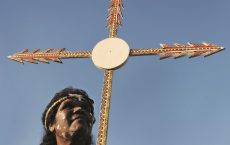
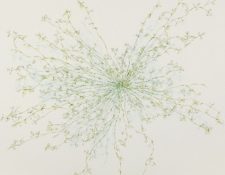
Teodoro Cano, No title, 2003.
Read More
-
Andrew M. Richmond
In a time when heat domes, wildfires, and floods regularly author human and nonhuman tragedy, the nature and magnitude of human-driven climate change understandably dominates media headlines, bestseller lists, and streaming-service titles alike. Ecological issues – and the roles of human beings within them – continue to attract the energies of artists and audiences, whether […]
Read More
-
Lisa Benjamin
Royal Dutch Shell is in the dock, at least in The Netherlands. The historic decision by The Hague District Court found that the Shell group’s inaction on climate change was a threat to human rights in The Netherlands. The Court decided that Royal Dutch Shell (RDS), as the parent company, had a best efforts obligation […]
Read More
-
Maggie McKinley
Image: courtesy of the Mailer historical archives
Read More
-
David Lindenfeld
The terms “World Christianity” and “global (or world) history” refer to academic fields that have become widespread in recent decades, reflecting the highly interconnected world we live in, and in part attempting to move away from an exclusively Western interpretation of how that world works. Yet it is striking that these fields have moved on […]
Read More
-
Johanna N. Y. Franklin, Christopher P. Porter
What does it mean for a sequence of 0s and 1s to be random? One way to answer this question is to use tools from mathematical logic, specifically computability theory: a sequence is random if it contains no regularities that can be detected by an idealized computer that has no time or space limitations.
Read More
-
Ailbhe Darcy
This month, we celebrate publication of A History of Irish Women’s Poetry. I asked a handful of the volume’s authors to tell us something about each of their chapters. Máirín Ní Dhonnchadha, NUI Galway: ‘Women in the Medieval Poetry Business’ Úallach (†934) daughter of Muimnechán is called banḟile Érenn in her obituary, a title that […]
Read More
-
Sara Forsdyke
As America reckons more fully with the legacy of slavery, and the world confronts the horrors of ongoing systems of oppression of peoples such as the Uyghurs in China and the Rohingya in Myanmar, what can we learn from the history of slavery in ancient Greece? This book argues that an understanding of ancient Greek […]
Read More
-
Germán Vergara
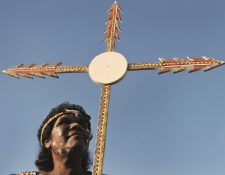
Teodoro Cano, No title, 2003....
Read More
-
Andrew M. Richmond
In a time when heat domes, wildfires, and floods regularly author human and nonhuman tragedy, the nature and magnitude of human-driven climate change understandably dominates media headlines, bestseller lists, and streaming-service titles alike. Ecological issues – and the roles of human beings within them – continue to attract the energies of artists and audiences, whether […]
Read More
-
Lisa Benjamin
Royal Dutch Shell is in the dock, at least in The Netherlands. The historic decision by The Hague District Court found that the Shell group’s inaction on climate change was a threat to human rights in The Netherlands. The Court decided that Royal Dutch Shell (RDS), as the parent company, had a best efforts obligation […]
Read More
-
Maggie McKinley
Image: courtesy of the Mailer historical archives...
Read More
-
David Lindenfeld
The terms “World Christianity” and “global (or world) history” refer to academic fields that have become widespread in recent decades, reflecting the highly interconnected world we live in, and in part attempting to move away from an exclusively Western interpretation of how that world works. Yet it is striking that these fields have moved on […]
Read More
-
Johanna N. Y. Franklin, Christopher P. Porter
What does it mean for a sequence of 0s and 1s to be random? One way to answer this question is to use tools from mathematical logic, specifically computability theory: a sequence is random if it contains no regularities that can be detected by an idealized computer that has no time or space limitations.
Read More
-
Ailbhe Darcy
This month, we celebrate publication of A History of Irish Women’s Poetry. I asked a handful of the volume’s authors to tell us something about each of their chapters. Máirín Ní Dhonnchadha, NUI Galway: ‘Women in the Medieval Poetry Business’ Úallach (†934) daughter of Muimnechán is called banḟile Érenn in her obituary, a title that […]
Read More
Number of articles per page: