Number of articles per page:
-
Amy Erica Smith
In August 2014, about seventy evangelical clergy in the Brazilian city of Juiz de Fora gathered for the monthly meeting of the local Council of Pastors. The worship/meeting space was an unadorned hall with white-painted cinderblock walls and the stage at the end farthest from the street entrance. After two and a half hours of […]
Read More
-
Victoria Wibeck, Björn-Ola Linnér
When UN Secretary-General Antonio Guterres at the recent Climate Action Summit in New York urged countries to “show the way towards a full transformation of economies in line with sustainable development goals”, this reflected the growing international science and policy attention to the need for fundamental, systemic, non-linear societal transformations to achieve sustainability, in response […]
Read More
-
Udi Sommer, Aliza Forman-Rabinovici
Once again, pro- and anti-abortion advocates are clashing across the United States. Will reigniting this conflict over defining moral issues spill over to influence abortion policy worldwide? Producing Reproductive Rights looks at the players around the globe who are both taking cues from this debate, as well as trying to influence it in their own […]
Read More
-
The website of GE mentions: “the relentless quest for progress has fueled 130 years of innovation. We believe that our people are our most powerful catalysts for growth and innovation”. At Google, the HR team, has revolutionized HR the same way Google has revolutionized search engines. HR is seen as a business partner and all […]
Read More
-
Hope M. Harrison
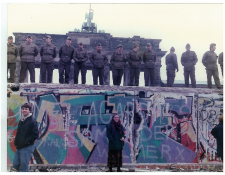
Hope M. Harrison at the Berlin Wall, November 11, 1989.
Read More
-
Margaret Tudeau-Clayton
In a lecture given in 1978 the Argentine writer Jorge Luis Borges observed that nations tend to choose authors to represent them that do not resemble their national character, citing, as a striking example, the discrepancy between a ‘hyperbolic’ Shakespeare and an England of ‘understatement’. His observation resonates with the central argument of my book, […]
Read More
-
Alan Outram, Amy Bogaard
Amy and I wrote Subsistence and Society: New Directions in Economic Archaeology, because the time was right to rethink the topic for two key reasons. Firstly, palaeoeconomics and environmental archaeology, which flourished from the 1950s to 80s, became quite unfashionable with the rise of post-processual critiques that accused it of ‘determinism’. However, like so many […]
Read More
-
Sophie Bergerbrant, Serena Sabatini
The production of textiles is a very ancient human endeavour. In pre-industrial settings, it was a complex and time-consuming craft that must have engaged a large part of the population. The product was both vital to society and in high demand. Clearly, not only has textile production been a major economic activity throughout history, but […]
Read More
-
Amy Erica Smith
In August 2014, about seventy evangelical clergy in the Brazilian city of Juiz de Fora gathered for the monthly meeting of the local Council of Pastors. The worship/meeting space was an unadorned hall with white-painted cinderblock walls and the stage at the end farthest from the street entrance. After two and a half hours of […]
Read More
-
Victoria Wibeck, Björn-Ola Linnér
When UN Secretary-General Antonio Guterres at the recent Climate Action Summit in New York urged countries to “show the way towards a full transformation of economies in line with sustainable development goals”, this reflected the growing international science and policy attention to the need for fundamental, systemic, non-linear societal transformations to achieve sustainability, in response […]
Read More
-
Udi Sommer, Aliza Forman-Rabinovici
Once again, pro- and anti-abortion advocates are clashing across the United States. Will reigniting this conflict over defining moral issues spill over to influence abortion policy worldwide? Producing Reproductive Rights looks at the players around the globe who are both taking cues from this debate, as well as trying to influence it in their own […]
Read More
-
The website of GE mentions: “the relentless quest for progress has fueled 130 years of innovation. We believe that our people are our most powerful catalysts for growth and innovation”. At Google, the HR team, has revolutionized HR the same way Google has revolutionized search engines. HR is seen as a business partner and all […]
Read More
-
Hope M. Harrison
Hope M. Harrison at the Berlin Wall, November 11, 1989....
Read More
-
Margaret Tudeau-Clayton
In a lecture given in 1978 the Argentine writer Jorge Luis Borges observed that nations tend to choose authors to represent them that do not resemble their national character, citing, as a striking example, the discrepancy between a ‘hyperbolic’ Shakespeare and an England of ‘understatement’. His observation resonates with the central argument of my book, […]
Read More
-
Alan Outram, Amy Bogaard
Amy and I wrote Subsistence and Society: New Directions in Economic Archaeology, because the time was right to rethink the topic for two key reasons. Firstly, palaeoeconomics and environmental archaeology, which flourished from the 1950s to 80s, became quite unfashionable with the rise of post-processual critiques that accused it of ‘determinism’. However, like so many […]
Read More
-
Sophie Bergerbrant, Serena Sabatini
The production of textiles is a very ancient human endeavour. In pre-industrial settings, it was a complex and time-consuming craft that must have engaged a large part of the population. The product was both vital to society and in high demand. Clearly, not only has textile production been a major economic activity throughout history, but […]
Read More
Number of articles per page: