Products and services

The Desert Fathers were the earliest Christian monks. They are the foundation stone of a movement that so developed over the centuries that it eventually wholly took over the Western Church and almost completely that of the East. Although monasticism has declined in recent centuries, various indications of its influence are still quite evident. Many […]
Read More
Simon Black, Author of, Species Conservation; Lessons from Islands, explains how our challenge is to understand how we can co-exist with nature by addressing two drivers of change. First, we need the positive efforts of the few people who have necessary technical skills to transform wild ecosystems. Second, we need to divert the negative impact of the millions of us human consumers (who create the problem in the first place) and reverse our psychological separation from the natural world.
Read More
Jamie A. Copsey, Author of Species Conservation, tells us how he thinks the world needs more positive perspectives on the future we want to shape, and then we can really start thinking about how we get there.
Read More
David Johns, Author of, Conservation Politics; The Last Anti-Colonial Battle, tells us how ultimately global conservation is failing. Why, when the majority of people say they value nature and its protection? David Johns argues that the loss of species and healthy ecosystems is best understood as human imposition of a colonial relationship on the non-human world - one of exploitation and domination.
Read More
Sergei Volis' book, Plant Conservation, argues that existing practises of plant conservation are inadequate and firmly supports the placement of ecological restoration at the cornerstone of biodiversity conservation. The author unifies different aspects of conservation into one coherent concept, including natural area protection, ex situ conservation and in situ interventions through either population management or ecological restoration.
Read More
Among the core cultural rights, outlined in the International Bill of Human Rights, are the rights to education, to participate in cultural life, to benefit from science and its products, and author’s rights. These rights promote cultural and scientific creativity. They also enable the pursuit of knowledge and understanding, thereby working as atrocity prevention tools. […]
Read More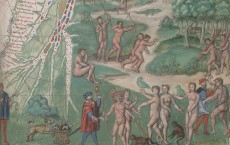
What IS that Patagonian giant doing on your Renaissance map? Surekha Davies tells us how she came to write her extraordinary, award-winning book, Renaissance Ethnography and the Invention of the Human: New Worlds, Maps and Monsters
Read More
The concept of totality has a long history. During the Twentieth Century and on in to the Twenty-First, however, there are two thinkers who have written almost obsessively on this concept and its relation to literary and cultural production. The first is Georg Lukács (1885-1971). Lukács has a varied approach to this idea. In some […]
Read MoreKeep up with the latest from Cambridge University Press on our social media accounts.