Products and services


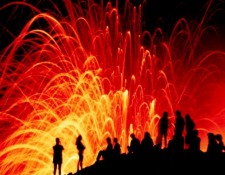
Rosaly Lopes, an expert in volcanoes on Earth and the planets at NASA's Jet Propulsion Laboratory, talks about the eruption of the volcano in Iceland that has flights worldwide grounded. So, you want to go see the Iceland volcano? If planes were flying to Iceland right now, would you go and see the eruption up close? Is it dangerous? How close can you actually get to an erupting volcano?
Read More
The idea of New York looms large over the landscape of American literature - a towering metropolis, a symbol of transience and mobility, of culture, of urbanism, and of change. From Harlem to the East Village, Times Square to Brooklyn, New York neighborhoods are defined by the different eras, enclaves, genres, and ideas that mark the literary and cultural history of the city. On Sunday, May 2, mark your calendars and save the date for the book launch of the Cambridge Companion to the Literature of New York. Editors Cyrus Patell and Bryan Waterman will be in attendance along with some of our favorite local contributors to commemorate the publication of the first large-scale consideration of New York’s legacy of literature. Please join us at the Bowery Poetry Club and Cafe for an evening exploring and celebrating writers in the city and portrayals of New York across more than two centuries of diverse writing and performance. And now, without further ado, I give you two more contributor profiles from Editors Cyrus Patell and Bryan Waterman, featured on Patell and Waterman’s History of New York. Meet Elizabeth (Betsy) Bradley (author of “Dutch New York from Irving to Wharton") and Melissa Bradshaw (author of “Performing Greenwich Village Bohemianism”).
Read More
Bjorn Lomborg, author of the internationally acclaimed The Skeptical Environmentalist, talks about stumbling in the dark during EARTH HOUR. In March, nearly a billion people participated – switching off their lights for an hour to raise awareness of global warming. Though sweet and well-intentioned, Lomborg argues that this movement lacked power in more ways than one. Pun intended. -------- Via The Project Syndicate Stumbling in the dark Bjorn Lomborg - 2010-04-01 SAO PAULO - As well-intentioned gestures go, Earth Hour is hard to beat. At the stroke of 8:30 p.m. on Saturday, March 27, nearly a billion people in more than 120 countries demonstrated their desire to do something about global warming by switching off their lights for an hour. In a show of official solidarity, the lights also went out at many of the planet’s most iconic landmarks, from the Opera House in Sydney to the Great Pyramid at Giza, not to mention Beijing’s Forbidden City, New York’s Empire State Building, London’s Big Ben, Paris’s Eiffel Tower, and the skylines of both Hong Kong and Las Vegas. What ever else it may be, Earth Hour is surely one of the most successful publicity stunts ever dreamed up. First organized in Sydney, Australia, in 2007 by the local chapter of the World Wildlife Fund, its popularity and the level of participation (both individual and official) that generates has exploded in recent years – to the point that there is barely a corner of the earth that the campaign hasn’t touched. As Greg Bourne, CEO of World Wildlife Fund in Australia, put it: “We have everyone from Casablanca to the safari camps of Namibia and Tanzania taking part.” But has Earth Hour actually done anything to halt – or even slow – global warming? Not so much. The event’s popularity is not hard to fathom. Who but the most die-hard global-warming denier could resist the notion, as Earth Hour’s American website phrased it this year, that merely “by flipping off your lights on March 27 at 8:30 p.m. local time you will be making the switch to a cleaner, more secure nation”? Needless to say, this was not quite the case. The main thing that anyone accomplished by turning off the lights at nighttime for an hour was to make it harder to see. Keep reading at The Project Syndicate > > >
Read More
Win money! Free books! Help us help you: takes literally less than a minute to fill out our survey…
Read More
My. Books. Do. Not. Smell. Like. Anything.
Read More
Evolution, global warming, human cloning, abortion rights. The cultural and political debates playing out on today’s world stage invoke frenetically partisan passions, and yet they are symptomatic of a broader cultural rift: the division between Christianity and science. Michael Ruse, author of Science and Spirituality: Making Room for Faith in the Age of Science, is a persistent figure on the frontlines of this divide. Negotiating the fine line between scientist and skeptic, Ruse pushes to show how it is possible for a believer of any faith to engage in an open and informed intellectual dialogue—for science and religion to coexist. He’s not alone. Over the weekend, Ruse blogged about the Templeton Foundation for The Huffington Post. The Foundation’s stated mission is “to serve as a philanthropic catalyst for discovery in areas engaging life’s biggest questions. These questions range from explorations into the laws of nature and the universe to questions on the nature of love, gratitude, forgiveness, and creativity.” This year, the Foundation honored Francisco J. Ayala with its prize for “a living person who has made an exceptional contribution to affirming life's spiritual dimension, whether through insight, discovery, or practical works. It is the world's largest annual monetary award given to an individual, currently valued at 1,000,000 pounds sterling.” (Past winners included Mother Teresa and Chuck Colson, former Watergate burglar -turned- born-again Christian). Yet no worthy award presentation is without controversy! Read on as Ruse dissects the role of the Templeton Foundation in influencing debate today (“It is hardly too strong a term to say that it is an object of derision by many of today's scientists…”), and accusations against Ruse’s friend Francisco Ayala – called a “master of non-committal waffle” by Minnesota biologist P.Z. Myers.
Read More
On the eve of the publication of Cambridge's latest addition to our Companion series – The CC to the Literature of New York – Editors Cyrus Patell and Bryan Waterman have started featuring profiles of their talented contributors. Meet Thomas Augst (author of “Melville, at Sea in the City") and Robin Bernstein (author of “Staging Lesbian and Gay New York”), the first two of this new series of profiles on Patell and Waterman’s History of New York: Being a … course, companion, blog, and book. And have a click through the website. It's got some great trivia, talking points, excerpts, and miscellany... eclectic as the city itself...
Read MoreHappy April 1st! Kudos to the vaulted halls of higher learning – good to see you’ve still got a sense of humor.
Read MoreKeep up with the latest from Cambridge University Press on our social media accounts.